


When you need a replacement alternator for your daily driver, or you’re sourcing a rebuilt transmission for a restoration project, understanding your shipping options can mean the difference between getting back on the road quickly and watching your vehicle sit in the garage for weeks. The right shipping choice also impacts your wallet—shipping a small sensor costs vastly different than moving a complete engine block across the country.
Car parts present unique shipping challenges. A delicate oxygen sensor requires different handling than a steel bumper. Time-sensitive repairs demand faster delivery than routine maintenance parts. Whether you’re a DIY enthusiast ordering parts online, a mechanic managing shop inventory, or an auto parts retailer fulfilling customer orders, knowing which shipping method matches your specific needs saves time, money, and frustration.
This guide breaks down every major shipping option available for automotive parts, helping you make informed decisions based on part type, urgency, budget, and destination.
Understanding Your Car Part Shipping Needs
Before diving into specific shipping methods, consider these factors that influence which option works best:
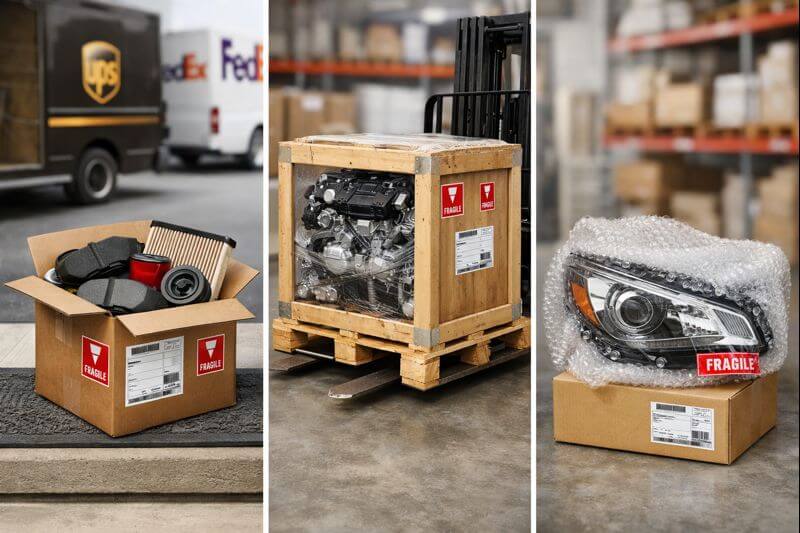
Part characteristics matter immensely. A timing belt weighs ounces and fits in a small box, while a differential assembly weighs 80+ pounds and requires substantial packaging. Fragile components like headlight assemblies need cushioned protection, whereas cast iron engine blocks can withstand rougher handling.
Urgency dictates options. If your vehicle is your only transportation to work, paying extra for expedited delivery makes sense. For project cars or preventive maintenance, standard shipping saves money without consequences.
Destination complexity varies. Shipping within the continental US offers straightforward options, while international shipments introduce customs documentation, duties, and extended transit times.
Budget constraints are real. Shipping costs can sometimes rival the part’s price, especially for heavy components. Balancing speed against cost requires understanding what you’re actually paying for.
Detailed Breakdown of Shipping Options
Standard Ground Shipping
Best for:
Small to medium-sized parts under 150 lbs, non-urgent deliveries, routine maintenance items
Standard ground shipping through carriers like UPS, FedEx, and USPS represents the most common method for shipping car parts. In our experience managing thousands of auto parts shipments, roughly 70% of orders under 50 pounds go this route.
Typical delivery times:
3-7 business days depending on distance. A shipment from California to Nevada might arrive in 3 days, while California to Maine could take the full week.
Cost range:
$10-$75 for most parts, scaling with weight and distance. A 5-pound brake rotor might cost $15 to ship cross-country, while a 40-pound radiator could run $50.
Pros:
- Cost-effective for most standard parts
- Reliable tracking systems
- Widely available with convenient drop-off locations
- Insurance options readily available
- Residential delivery included
Cons:
- Not suitable for extremely heavy parts (100+ lbs)
- No guaranteed delivery dates with basic service
- Weekend delivery costs extra
- Dimensional weight pricing can surprise you on bulky items
Commonly shipped parts:
Brake pads, filters, sensors, belts, hoses, alternators, starters, batteries (with hazmat restrictions), headlights, taillights, mirrors, interior trim pieces, and small body panels.
Expedited Shipping (2-Day and Overnight)
Best for:
Urgent repairs, time-sensitive deliveries, high-value parts requiring quick turnaround
When a customer’s car is immobilized and they need it running by morning, expedited shipping becomes essential despite higher costs. We’ve seen mechanics pay $100+ to overnight a $40 fuel pump because the customer absolutely needs their vehicle.
Typical delivery times:
Overnight (next business day), 2-Day, or 3-Day options available
Cost range: $25-$200+ depending on weight and service level. Overnight shipping for a 10-pound transmission solenoid from Texas to Michigan might cost $75, while 2-day service drops to $35.
Pros:
- Minimizes vehicle downtime
- Guaranteed delivery dates with money-back promises
- Priority handling reduces damage risk
- Weekend delivery available (at premium pricing)
- Later cutoff times for same-day dispatch
Cons:
- Significantly more expensive than ground
- Weight limits still apply (typically 150 lbs max)
- Doesn’t help if parts aren’t in stock
- Overnight means next business day (ordering Friday means Monday delivery)
Commonly shipped parts:
Critical failure components like fuel pumps, ECUs, sensors causing check engine lights, ignition coils, timing chains, water pumps, and any part preventing vehicle operation.
Pro tip: Check if your parts supplier offers “will call” or local pickup. If they have a distribution center within driving distance, you’ll get parts faster than overnight shipping and save money.
LTL Freight Shipping (Less-Than-Truckload)
Best for:
Heavy parts (150-10,000 lbs), large components, multiple parts shipped together, commercial deliveries
LTL freight bridges the gap between standard parcel shipping and full truckload service. Your shipment shares truck space with other freight, making it cost-effective for heavy automotive components that exceed parcel carrier limits.
Typical delivery times:
3-10 business days depending on distance and number of terminals involved
Cost range:
$150-$800+ based on weight, dimensions, distance, and accessorial charges. Shipping a 300-pound transmission from Detroit to Denver might cost $250, while a 600-pound engine block to the same destination could run $400.
Pros:
- Handles extremely heavy parts (complete engines, transmissions, differentials, axles)
- More economical than parcel for heavy items
- Liftgate service available for residential delivery
- Inside delivery options available
- Can ship palletized multiple parts together
Cons:
- Requires commercial address or liftgate service (adds $75-150)
- Terminal-to-terminal transit takes longer
- Must be available during business hours for delivery
- Freight classification complexity affects pricing
- Accessorial charges add up (residential, liftgate, inside delivery, limited access)
Commonly shipped parts:
Complete engines, transmissions, transfer cases, differentials, axle assemblies, chassis components, large body panels (hoods, doors, fenders), truck beds, and bulk part orders.
Important packaging note:
Freight carriers expect proper crating or palletizing. We’ve seen claims denied because engines shipped on pallets without protective crating sustained damage during multiple handlings through terminals.
FTL Freight Shipping (Full Truckload)
Best for: Extremely large shipments, complete vehicle conversions, commercial bulk orders, time-sensitive heavy freight
Full truckload shipping dedicates an entire truck to your shipment. While expensive, it makes sense when shipping volumes justify it or when you’re moving complete drivetrain swaps, multiple engines, or commercial inventory.
Typical delivery times: 1-5 days depending on distance, often faster than LTL because there’s no terminal switching
Cost range: $1,500-$5,000+ for cross-country shipments, varying by distance, equipment type, and urgency
Pros:
- Fastest option for heavy freight
- Minimal handling reduces damage risk
- Direct point-to-point shipping
- Flexible scheduling
- Cost-effective when shipping volume is high enough
Cons:
- Extremely expensive for small shipments
- Overkill unless shipping substantial volume
- Requires loading dock or forklift access
- You pay for full truck whether it’s full or not
Commonly shipped parts: Commercial inventory shipments, complete vehicle restorations (all parts for one project), racing team equipment, dealer inventory transfers, salvage yard bulk purchases.
Air Freight
Best for: International express shipping, extremely urgent domestic needs, high-value low-weight parts
Air freight rarely makes sense for domestic car parts shipping due to cost, but it’s sometimes the only option for international emergency shipments or when aircraft downtime costs exceed shipping expenses (yes, aircraft use some automotive components).
Typical delivery times:
1-3 days internationally, next-day domestically
Cost range:
$200-$2,000+ depending on weight, distance, and service level
Pros:
- Fastest international option
- Reliable for critical situations
- Good for high-value, low-weight items
Cons:
- Prohibitively expensive for most applications
- Still requires ground transportation on both ends
- Customs clearance can delay international shipments
- Weight and size restrictions apply
Commonly shipped parts:
Rare vintage parts sourced internationally, racing components needed for competition, specialized sensors or electronics, prototype components.
International Shipping
Best for: Overseas part sourcing, international resale, expatriate vehicle maintenance
Shipping car parts internationally introduces complexity beyond choosing a carrier. Customs documentation, import duties, prohibited items lists, and longer transit times all factor in.
Typical delivery times: 7-30+ days depending on method (express international vs. standard) and customs efficiency
Cost range: $50-$500+ for parcel shipments, significantly more for freight
International shipping considerations:
Customs and duties: You’ll need commercial invoices describing parts, values, and country of origin. Import duties vary by country and part type. We’ve seen customers in Europe pay 20%+ import VAT on parts from the US.
Harmonized System (HS) codes: Proper classification determines duty rates. Misclassification causes delays and potential fines.
Prohibited items: Some countries restrict or prohibit certain automotive parts. Catalytic converters containing precious metals face scrutiny. Parts from endangered species (some vintage leather components) are banned.
Packaging requirements: International shipments need more robust packaging due to extended handling. Waterproof wrapping helps with sea freight.
Shipping methods:
- Express international (DHL, FedEx International Priority, UPS Worldwide Express): 2-5 days, expensive but includes customs clearance assistance
- Standard international: 7-21 days, more economical, may require recipient to handle customs
- International freight: 14-45 days for sea freight, cost-effective for heavy items
Commonly shipped internationally: Performance parts not available locally, OEM parts from vehicle’s country of origin, vintage parts from specialized overseas suppliers, aftermarket accessories.
Expert insight: Always check your country’s import regulations before ordering. I’ve worked with customers who ordered $2,000 in performance parts only to discover their country prohibited the modifications, resulting in parts being seized or returned at their expense.
Local Courier and Same-Day Delivery
Best for: Extreme urgency, local suppliers, avoiding shipping costs on readily available parts
Some parts suppliers and auto parts retailers offer local courier service or partner with services like Uber Freight, Roadie, or dedicated courier services for same-day delivery within metro areas.
Typical delivery times: 1-4 hours for same-day service
Cost range: $15-$100 depending on distance and part size
Pros:
- Fastest option available
- No overnight waiting
- Keeps local vehicles running quickly
- Often cheaper than expedited shipping for local deliveries
Cons:
- Geographic limitations (usually 25-50 mile radius)
- Not available from all suppliers
- Limited to what’s in stock locally
- May have size/weight restrictions
Commonly shipped parts: Emergency replacement parts, critical components for commercial vehicles, parts for mobile mechanics on job sites.
Shipping Considerations by Part Type
Large and Heavy Car Parts
Engines, transmissions, differentials, and other major drivetrain components require special handling:
Crating is essential. A bare engine on a pallet will likely sustain damage. Proper wooden crating protects mounting points, exposed components, and prevents shifting during transit.
Drain all fluids. Carriers classify automotive fluids as hazardous materials. Drain oil, coolant, and transmission fluid before shipping. Some residual fluid is acceptable, but visible leakage causes shipment refusal.
Secure loose components. Zip-tie or wire-tie any loose wiring, hoses, or accessories to the main component. We’ve seen distributor caps arrive separate from engines because they weren’t secured.
Declare accurate weight. Freight carriers calculate charges partially on weight. A complete V8 engine typically weighs 400-600 pounds including crate. Underestimating weight leads to additional charges or shipment refusal.
Consider freight class. Freight shipping uses classifications (50-500) based on density, handling, and liability. Auto parts typically fall into classes 70-125, affecting pricing substantially.
Fragile or High-Value Parts
Headlight assemblies, custom body panels, chrome trim, and electronics require extra protection:
Double-boxing works wonders. Place the part in a box with 2-3 inches of cushioning on all sides, then place that box inside a larger box with additional cushioning.
Use appropriate materials. Bubble wrap for glass and plastic, foam corner protectors for panels, anti-static bags for electronics, and never use packing peanuts alone—they shift during transit.
Purchase insurance. Standard carrier liability covers $100 or less. A $500 headlight assembly needs declared value insurance. This typically costs 1-3% of the declared value.
Require signature. Signature confirmation costs $3-6 but prevents porch piracy and provides proof of delivery.
Mark boxes appropriately. “Fragile” stickers don’t guarantee gentle handling, but they don’t hurt. More importantly, use “This End Up” arrows for parts with correct orientation requirements.
Packaging Requirements and Best Practices
Proper packaging prevents 90% of shipping damage claims:
Box selection: Use new, double-wall corrugated boxes for heavy parts. Single-wall boxes work for items under 20 pounds. Box dimensions matter—oversized boxes trigger dimensional weight pricing.
Cushioning materials:
- Bubble wrap (large bubbles for big items, small for delicate parts)
- Foam sheets and corner protectors
- Air pillows
- Crumpled kraft paper
- Purpose-made foam inserts for highly fragile items
Wrapping oily parts: Even drained parts retain residual oil. Wrap in plastic bags before boxing to prevent carrier rejection for leaking packages.
Batteries require special handling: Automotive batteries are hazardous materials. They need specific packaging and labeling. Many carriers require retailer-level hazmat certification for battery shipping. Consumer shipments often get rejected.
Painting and finishing: Newly painted or powder-coated parts need extra care. Wrap in soft material before cushioning to prevent surface scratches.
Comparison Table: Shipping Options at a Glance
-$-$
| Shipping Method | Cost | Speed | Weight Limit | Best For | Reliability |
|---|---|---|---|---|---|
| Standard Ground | $ | 3-7 days | Up to 150 lbs | Small-medium parts, routine orders | High |
| 2-Day Express | $$ | 2 days | Up to 150 lbs | Urgent repairs, critical components | Very High |
| Overnight | $$$ | 1 day | Up to 150 lbs | Emergency situations, vehicle down | Very High |
| LTL Freight | 3-10 days | 150-10,000 lbs | Engines, transmissions, heavy parts | Moderate-High | |
| FTL Freight | $$$$ | 1-5 days | 10,000+ lbs | Bulk commercial orders | High |
| Air Freight | $$$$ | 1-3 days | Varies | International express, extreme urgency | High |
| International Standard | 7-30 days | Varies | Overseas sourcing, non-urgent | Moderate | |
| Local Courier | −- −$ | 1-4 hours | Up to 100 lbs | Same-day needs, local availability | High |
Key: $ = 10-50 | $ = 50-150 | $ $ = 150-500 | $ $$ = $500+
Tracking, Insurance, and Delivery Confirmation
Tracking capabilities: All major carriers provide real-time tracking. For expensive parts, I recommend carriers offering photo confirmation of delivery and GPS-verified drop-off locations.
Insurance options:
- Carrier liability: Usually covers only $100 maximum
- Declared value: Pay extra to insure actual part value (typically 1-3% of value)
- Third-party insurance: ShipInsure and similar services sometimes cost less than carrier insurance
Signature requirements:
- Standard: No signature, left at door
- Signature required: Someone must sign
- Adult signature: Recipient must be 21+ (rarely needed for parts)
Best practice: For parts over $200, purchase declared value insurance and require signature confirmation.
Customs, Duties, and International Regulations
International shipping introduces regulatory complexity:
Required documentation:
- Commercial invoice (describes parts, values, country of origin)
- Customs declaration
- Certificate of origin (sometimes)
- Import permits (for certain parts in certain countries)
Common issues:
- Undervalued declarations: Declaring parts at lower values to reduce duties is illegal and risks seizure
- Incorrect HS codes: Proper classification is essential; errors cause delays
- Prohibited items: Some countries ban certain modifications or parts types
- VAT and import duties: Can add 20-50% to part cost in some countries
De minimis values: The US allows imports under $800 duty-free from most countries. Other countries have lower thresholds (Canada: CAD $20, EU: €150).
USMCA/NAFTA considerations: Parts manufactured in the US, Canada, or Mexico may qualify for reduced or zero duties when shipped between these countries.
Return Shipping Considerations
Returns happen—wrong parts, manufacturing defects, changed plans:
Who pays return shipping?
- Seller error or defective part: Seller should provide prepaid return label
- Buyer error (wrong part ordered): Buyer typically pays return shipping
- Buyer’s remorse: Depends on seller’s return policy
Return packaging: Use original packaging when possible. Sellers often deny returns for parts damaged due to inadequate return packaging.
Restocking fees: Many sellers charge 15-25% restocking fees on returns, especially for special-order parts.
Return timeframes: Typical return windows range from 30-90 days, but opened electrical components and special orders often aren’t returnable.
Expert tip: Before ordering expensive or non-standard parts, verify fitment using VIN decoders and part number cross-references. Returning a $1,200 transmission because it doesn’t fit costs $150+ in shipping both ways, plus potential restocking fees.
Frequently Asked Questions
What is the cheapest way to ship car parts?
For small parts under 5 pounds, USPS often beats UPS and FedEx, especially for zones 1-4. For heavier parts, compare rates between carriers—prices vary significantly by route and current carrier promotions. Shipping to commercial addresses saves money versus residential. For heavy parts over 150 pounds, LTL freight shared with other shipments beats parcel shipping substantially.
Can car parts be shipped internationally?
Yes, most car parts ship internationally, but certain items face restrictions. Batteries are hazardous materials requiring special handling. Some countries prohibit performance modifications or emissions-related parts. Fluids cannot ship internationally via standard methods. Always verify destination country regulations before ordering. Expect customs duties, VAT, and longer delivery times (typically 7-30 days).
How long does shipping car parts usually take?
Standard ground shipping takes 3-7 business days domestically. Expedited services deliver in 1-3 days. LTL freight requires 3-10 days. International shipping ranges from 2-5 days for express services to 7-30+ days for standard international. Actual times depend on origin, destination, customs clearance, and current carrier volume. Always add buffer time for critical repairs.
Are car parts considered hazardous materials?
Some are. Batteries, certain airbag components, fluids (oil, coolant, brake fluid), pressurized containers (spray paint, refrigerant), and anything with lithium batteries fall under hazmat regulations. These items require special packaging, labeling, and carrier certification. Most structural and electronic components ship as regular freight. When in doubt, check with carriers before shipping.
How should car parts be packaged for shipping?
Use sturdy double-wall boxes for parts over 20 pounds. Provide 2-3 inches of cushioning (bubble wrap, foam, air pillows) on all sides. Wrap oily parts in plastic to prevent leakage. Secure loose components with zip ties. Mark “Fragile” and “This End Up” where appropriate. For heavy parts, use wooden crating. For fragile items, consider double-boxing. Proper packaging prevents 90% of damage claims.
Do I need insurance when shipping car parts?
For parts under $100, standard carrier liability might suffice. For anything more valuable, purchase declared value insurance—it costs 1-3% of the part’s value but covers damage or loss. A $600 transmission should have $600 declared value coverage. Without it, you’ll only receive $100 maximum from carriers. Insurance also incentivizes careful handling.
Can oversized car parts be shipped?
Yes, through freight services. Hoods, fenders, bumpers, doors, and other large body panels ship via LTL freight when properly crated or boxed. Complete chassis and frames require FTL freight. Parcel carriers have maximum size limits (typically 108-165 inches in length + girth), beyond which freight becomes necessary. Oversized items cost more due to dimensional weight pricing or freight classifications.
What’s the difference between LTL and FTL freight?
LTL (Less-Than-Truckload) means your shipment shares truck space with other freight, making it economical for shipments between 150-10,000 pounds. Transit takes longer due to multiple stops and terminal transfers. FTL (Full Truckload) dedicates an entire truck to your shipment—faster and safer but expensive unless you’re filling substantial truck space. For a single engine, use LTL. For 15 engines, consider FTL.
Conclusion
Selecting the right shipping method for car parts requires balancing speed, cost, and part-specific needs. Standard ground shipping handles most routine orders economically, while expedited services minimize critical downtime. Heavy components like engines demand LTL freight solutions, and international shipments require careful customs planning. Always prioritize proper packaging regardless of carrier choice—it’s your best defense against damage claims. For parts under $200, standard shipping usually suffices, but high-value components justify insurance and signature confirmation. Understanding these options empowers you to make cost-effective decisions that get your vehicle back on the road without unnecessary delays or expenses.