
You’re standing in front of your computer, staring at an online auto parts catalog, and suddenly you’re hit with a wave of doubt. Is this really the right brake caliper for my Honda? Will this air filter actually fit my engine? What if I order the wrong part and waste my money—or worse, damage my car?
I’ve been a technician for over 15 years, and I can tell you: you’re not alone. Every week, someone walks into the shop with a bag full of parts that don’t fit. Sometimes it’s a simple mix-up between model years. Other times, it’s a more complex issue like buying a sensor designed for a different engine variant. The good news? Learning to identify the correct part for your specific vehicle is simpler than you think once you know what to look for.
Let’s walk through everything you need to know to buy with confidence and avoid expensive mistakes.
Why Many Car Parts Must Be Vehicle-Specific
Here’s the reality: modern cars are incredibly complex machines with thousands of engineered components. Even vehicles that look identical on the outside can have major differences under the hood.
Engine variations are one of the biggest culprits. Your 2018 Ford F-150 might have come with a 2.7L EcoBoost, a 3.3L V6, a 3.5L EcoBoost, or a 5.0L V8. Parts like spark plugs, fuel injectors, motor mounts, and timing components are completely different between these engines—even though they’re all F-150s from the same year.
Electronics and sensors are another minefield. A mass airflow sensor for a 2015 Toyota Camry with the 2.5L engine won’t work on the same Camry with the 3.5L V6. Modern vehicles use computer-controlled systems that expect very specific signals. Install the wrong sensor, and your check engine light becomes your new best friend.
Trim levels and options packages matter more than most people realize. The base model might have manual door locks while the luxury trim has power locks with integrated alarm sensors. Trying to swap these parts between trims can lead to fitment nightmares or complete electrical failures.
Model year changes happen quietly. Manufacturers make running changes mid-year or redesign components between model years. A 2019 part might look identical to a 2020 version but have subtle differences in mounting points, connector types, or dimensions.
Think of your car like a custom-tailored suit. Sure, you might be able to borrow your friend’s jacket in a pinch, but it probably won’t fit quite right. Vehicle parts work the same way.
7 Clear Signs You Need a Specific Part for Your Car
Not sure if your repair requires an exact match? Here are the telltale signs that you need a vehicle-specific part:
1. The parts website requires your VIN or detailed vehicle information. When a reputable seller asks for your 17-digit Vehicle Identification Number before showing you parts, that’s your first clue. They’re doing this to ensure compatibility—not to make your life difficult.
2. Multiple part numbers exist for what seems like the same component. Ever searched for brake pads and found six different options for your exact year and model? Those variations aren’t random. They correspond to different brake systems, wheel sizes, or trim packages.
3. Engine size or type is specified in the listing. If the part description mentions “for 2.0L engine only” or “V6 models,” pay attention. This means physically different parts exist for different powertrains.
4. Model year ranges are narrow or specific. When you see “fits 2015-2017 only” followed by “2018-2020 uses different part,” that’s a redesign. The manufacturer changed something significant between those generations.
5. The component involves electronics or computer calibration. Modules, sensors, actuators, and any part with a wiring connector usually needs precise matching. Your car’s computer is expecting specific communication protocols.
6. Mounting points, brackets, or dimensions are mentioned. Statements like “note: early production vs late production” or “check mounting bolt pattern” mean you need to verify fitment carefully. Mechanical differences exist even within the same model year.
7. It’s a safety-critical component. Brakes, airbags, seat belts, steering components, and suspension parts should always match manufacturer specifications exactly. These aren’t areas where you want to experiment with “close enough.”
The 5 Most Reliable Ways to Identify the Correct Car Part
Now that you know when precision matters, let’s talk about how to actually find the right part.
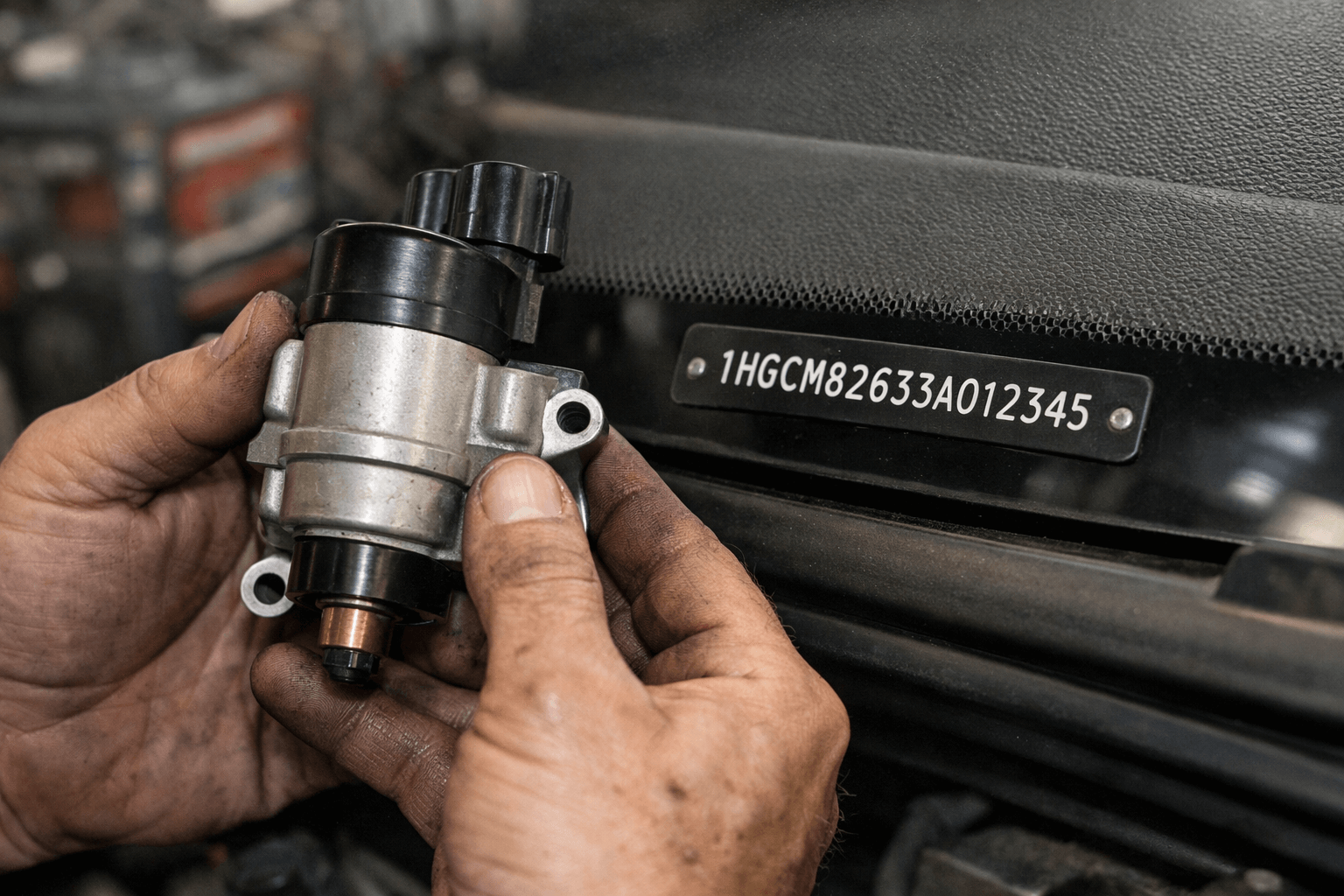
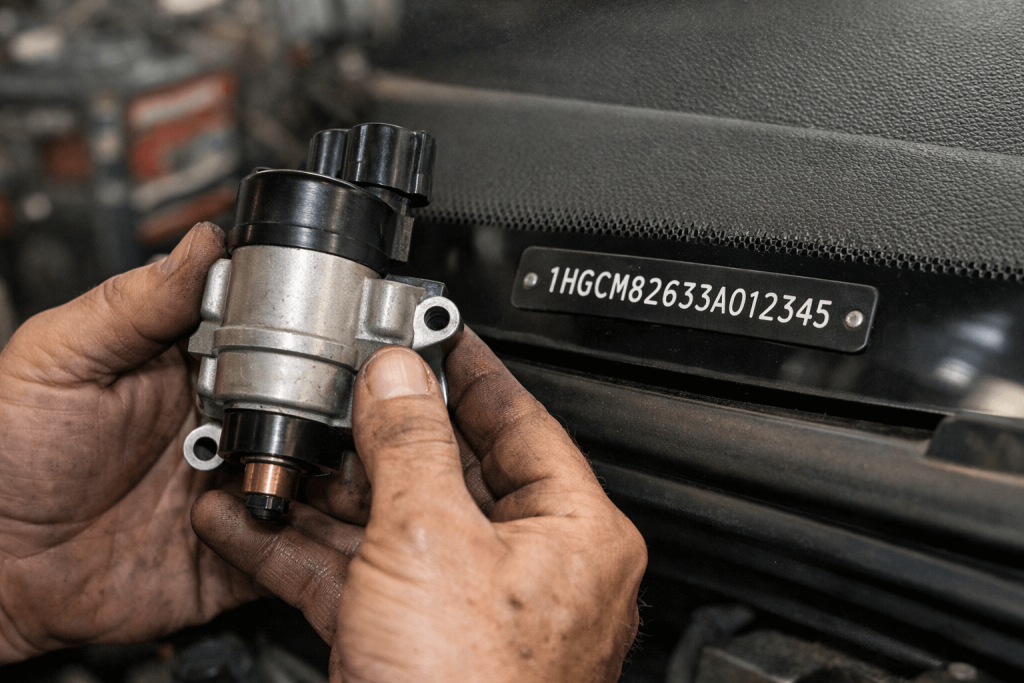
VIN lookup is your best friend. Your Vehicle Identification Number is like your car’s DNA. It tells you the exact factory specifications: engine type, transmission, production date, assembly plant, and more. Most quality parts retailers have VIN decoders on their websites. Just enter those 17 characters and the system filters out incompatible parts automatically. You’ll find your VIN on the driver’s side dashboard (visible through the windshield), inside the driver’s door jamb, or on your registration documents.
Check your owner’s manual. I know, I know—nobody reads these anymore. But buried in those pages are part specifications, fluid capacities, and replacement intervals with exact part types. The maintenance schedule section often lists OEM part numbers for common wear items like filters, spark plugs, and wiper blades.
Use the old part number. This is the method professionals rely on most. Almost every automotive part has a number stamped, molded, or labeled somewhere on it. Pop your hood, crawl under your car (safely, please), and find that number on the component you’re replacing. A quick internet search of that part number will tell you exactly what you need and often reveal compatible aftermarket alternatives.
Call the dealership parts department. Yes, you might pay a premium buying from the dealer, but their parts counter staff have access to comprehensive databases. Give them your VIN and describe what you need. They’ll provide the exact OEM part number, which you can then use to shop around for better prices. Even if you don’t buy from them, this information is gold.
Use trusted parts databases with vehicle-specific filters. Sites like RockAuto, AutoZone, and Advance Auto Parts have invested heavily in fitment databases. When you enter your year, make, model, and engine, these systems cross-reference thousands of applications. Just make sure you’re selecting the correct vehicle profile—double-check engine size and options.
Can You Use a Different or Universal Part Instead?
Here’s where things get interesting. Some parts are genuinely universal, while others claiming to be “universal” are a recipe for frustration.
Truly universal parts do exist and work beautifully. Floor mats (basic rubber ones), some battery chargers, diagnostic code readers, certain fuel additives, tire pressure gauges, and basic hand tools like wrenches fall into this category. Nobody’s checking your VIN when you buy windshield washer fluid.
“Universal fit” parts that require modification are a gray area. Things like aftermarket cold air intakes, exhaust systems, or stereo components often claim universal compatibility but need custom brackets, trimming, or adaptation. If you’re handy and patient, these can work. If you want a bolt-on experience, stick with vehicle-specific options.
Parts you should never treat as universal include anything related to safety, emissions, or computer systems. Brake components, airbag sensors, catalytic converters, oxygen sensors, and engine control modules must match your vehicle exactly. I’ve seen drivers try to save $30 on an oxygen sensor only to spend $500 diagnosing why their car runs terribly afterward.
A good rule of thumb: if the part bolts directly to your engine, transmission, suspension, or brake system, it probably needs to be vehicle-specific. If it’s an accessory or tool, universal might work fine.
OEM vs Aftermarket: Does It Affect Compatibility?
This question comes up constantly, and the answer is more nuanced than “OEM is always better” or “aftermarket is just as good.”
OEM (Original Equipment Manufacturer) parts are made by or for the company that built your car. When you buy a Honda part from a Honda dealer, you’re getting the same component that was installed at the factory. The upside? Perfect fit, guaranteed compatibility, and often a warranty that protects you. The downside? Higher cost, and you’re limited to one supplier.
Aftermarket parts are made by third-party companies. Quality varies wildly—from premium brands that exceed OEM specifications to budget options that barely meet minimum standards. Reputable aftermarket manufacturers like Bosch, Denso, ACDelco, Moog, and Monroe invest in engineering parts that match or improve on OEM performance. They’re usually cheaper and sometimes offer better warranties than OEM.
Here’s what matters for compatibility: a quality aftermarket part designed for your specific vehicle will fit and function correctly. The key phrase is “designed for your specific vehicle.” A cheap universal alternator from an unknown brand? That’s a gamble. A Bosch alternator specifically listed for your year, make, model, and engine? That’s a safe bet.
Read reviews, check return policies, and consider the part’s function. For critical components like brakes or suspension, spending a bit more on a trusted brand—whether OEM or premium aftermarket—buys peace of mind. For routine items like air filters or wiper blades, mid-tier aftermarket parts work perfectly fine.
What Happens If You Install the Wrong Part?
Let’s talk consequences, because understanding the risks helps you appreciate why precision matters.
Performance issues are the most common outcome. Install the wrong spark plugs with incorrect heat range or gap, and your engine misfires, loses power, and guzzles fuel. Use brake pads designed for a lighter vehicle, and your stopping distance increases dangerously.
Damage to other components is expensive. Force a sensor connector that doesn’t quite match, and you’ll crack the housing or bend pins. Mount an alternator with the wrong bracket, and the vibration destroys the bearings within weeks. I’ve seen DIYers cause $2,000 in damage trying to install a $150 part that didn’t fit.
Safety failures are the nightmare scenario. Incorrect brake calipers might physically bolt on but provide insufficient stopping force. The wrong airbag module won’t deploy correctly in a crash. Suspension components that don’t match specs can lead to catastrophic handling failures.
Wasted time and money might not be life-threatening, but they hurt. You order a part, wait for shipping, discover it doesn’t fit, then deal with returns and shipping costs. Now you’re without your car longer and you’re frustrated.
Check engine lights and failed emissions happen when sensors or computer modules don’t match. Your car’s ECU (engine control unit) expects specific signals. The wrong part sends wrong data, triggering fault codes. In regions with emissions testing, this means you can’t register your vehicle.
The bottom line: spending an extra 10 minutes confirming compatibility saves hours of headaches and potentially hundreds in replacement costs.
Expert Tips to Avoid Buying the Wrong Auto Part
After years of watching people make the same mistakes, here’s my practical checklist:
Always verify your engine size and type. Don’t guess. Pop your hood and look for the engine code sticker, or check your door jamb sticker. A 2.5L and a 3.0L engine are completely different animals.
Take clear photos of the old part before removing it. Capture all angles, connector types, mounting points, and any visible part numbers. When you’re at the parts store or online, you can compare these photos to ensure an exact match.
Count mounting holes, measure bolt patterns, and check connector pins. This sounds tedious, but it takes 30 seconds and catches errors. If your old brake caliper has two mounting bolts and the new one has three, you’ve got the wrong part.
Don’t assume “it’s all the same within the generation.” Manufacturers make mid-cycle updates. A 2016 model might differ from a 2017, even if the body style didn’t change. Always use your specific year.
Ask questions before clicking “buy.” Reputable sellers have customer service teams or chat support. If you’re uncertain, ask: “I have a 2014 Accord EX-L with the 3.5L V6. Will this fit?” Good retailers confirm fitment or help you find the right alternative.
Check return policies. Mistakes happen. Buy from retailers that accept returns on uninstalled parts without restocking fees. This safety net protects you if the database was wrong or you selected the incorrect vehicle profile.
Use multiple sources to verify. Cross-reference part numbers across different websites. If RockAuto, AutoZone, and the dealership all show the same part number for your application, you’re probably good. If one source shows something different, dig deeper.
For complex jobs, consider getting a professional opinion. If you’re replacing something expensive or critical—transmission parts, engine internals, hybrid system components—a quick consultation with a mechanic can save you from costly mistakes. Most shops charge minimal diagnostic fees that pale compared to buying wrong parts.
Compatibility Checklist: Quick Reference
Before finalizing any parts purchase, run through this mental checklist:
✓ Do I have my exact year, make, and model confirmed?
✓ Have I identified my specific engine size and type?
✓ Have I entered my VIN or used vehicle-specific filters?
✓ Does the part listing specifically mention my vehicle?
✓ Have I verified the old part number matches the new one?
✓ Are the photos/descriptions consistent with my original part?
✓ Have I checked customer reviews for fitment issues?
✓ Does the seller offer returns on uninstalled parts?
✓ For safety components, am I using OEM or trusted premium aftermarket?
✓ Have I double-checked that trim level and options match?
When to Ask a Mechanic
DIY repairs save money, but some situations warrant professional help:
- You’re working on safety systems (brakes, airbags, steering, suspension)
- The repair involves specialized tools or calibration equipment
- You’re unsure about diagnostic results and might be replacing the wrong part
- The vehicle has complex electronics or hybrid/electric systems
- You’ve already installed a part and something isn’t working correctly
- The part fitment seems unclear even after research
A good mechanic doesn’t mind questions. Many will quickly verify a part number or give you a fitment opinion for a small fee or even free if you’re a regular customer. This tiny investment protects you from expensive mistakes.
Parts That Must Always Match Your VIN
Certain components should never be treated as “close enough”:
Safety systems: All brake components, airbag modules, seat belt assemblies, ABS sensors, and traction control components.
Engine management: ECU/PCM modules, transmission control modules, oxygen sensors, mass airflow sensors, throttle bodies with electronic control.
Powertrain: Engine internals, transmission parts, driveshafts, CV axles, motor mounts designed for specific engine weights.
Emissions: Catalytic converters, EVAP system components, EGR valves, PCV systems (especially important for passing inspection).
Steering and suspension: Rack and pinion assemblies, power steering pumps, control arms, struts/shocks, steering columns.
Parts That Are Usually Universal
These items typically don’t require VIN-specific matching:
- Basic hand tools and equipment
- Battery chargers and jump starters
- Diagnostic code readers (though professional scan tools may be vehicle-specific)
- Rubber floor mats without custom molding
- Standard fluids (though you must use the correct specification)
- Many cleaning products and accessories
- Basic tire pressure gauges
- Funnel sets and drain pans
FAQs:
Do car parts have to match exactly?
It depends on the part. Safety-critical components, electronics, and anything bolted to the engine or transmission should match your vehicle’s exact specifications. Accessories and basic maintenance items often have more flexibility. When in doubt, verify using your VIN or part numbers.
Can my VIN tell me the exact part I need?
Yes and no. Your VIN identifies your vehicle’s factory specifications—engine type, transmission, build date, and options. Parts retailers use this to filter compatible parts. However, the VIN itself doesn’t directly give you a part number. It’s a lookup tool that helps databases determine which parts fit your specific configuration.
Are parts different by trim level?
Absolutely. Base, mid-level, and luxury trims often use different components. Power accessories, larger brakes, upgraded suspension, different wheel sizes, and enhanced electronics all vary by trim. Always verify your exact trim level when ordering parts.
Are aftermarket parts safe?
Quality aftermarket parts from reputable manufacturers are completely safe and often identical to OEM parts (sometimes even made in the same factories). The key is choosing trusted brands with good reviews and proper certifications. Avoid unknown brands offering prices that seem too good to be true—they usually are.
What if the parts website shows multiple options for my exact vehicle?
This is normal. Manufacturers often used different suppliers or made running changes during a model year. Look for additional filters like production date, engine code, or transmission type. If you’re still unsure, contact customer service with your VIN—they can narrow it down.
Can I use a part from a junkyard or salvage yard?
Used parts can be a cost-effective option, especially for things like body panels, interior trim, or certain mechanical components. Make sure the donor vehicle matches your year, model, and specifications as closely as possible. I’d avoid used safety components, electronics, or anything with unknown wear history.
Conclusion
Identifying the right car part doesn’t have to be overwhelming. Start with your VIN, verify your engine size, and use vehicle-specific filters when shopping online. Remember that safety-critical components like brakes, sensors, and electronics must match your exact specifications—this isn’t an area to cut corners. When in doubt, cross-reference part numbers, check reviews, and don’t hesitate to ask professionals for confirmation. The few extra minutes you invest in verifying compatibility will save you from installation headaches, wasted money, and potential safety risks. Buy smart, install confidently, and keep your vehicle running safely for years to come.