
If you’ve ever needed a replacement part for your vehicle, you’ve probably wondered: Can I just buy this directly from the manufacturer and skip the middleman? It’s a logical question—especially when you’re comparing prices between your local auto parts store, the dealership, and what you imagine the “factory price” might be.
The short answer is: sometimes, but rarely for individual consumers. Most order car parts manufacturers don’t sell directly to the general public. However, there are important exceptions, workarounds, and alternative strategies that can save you money and ensure you’re getting genuine parts.
In this guide, I’ll walk you through exactly how the automotive parts supply chain works, when direct ordering is possible, what the real barriers are, and—most importantly—your best alternatives when buying straight from the manufacturer isn’t an option.
Quick Answer: Can You Buy Car Parts Directly from Manufacturers?
For most individual car owners: No. Major OEM (Original Equipment Manufacturer) parts suppliers like Bosch, Denso, Continental, or Delphi typically require:
- Business licenses or tax IDs
- Minimum order quantities (MOQs) that can range from 50 to 500+ units
- Established accounts with credit terms
- Commercial shipping addresses
However, you can order directly if:
- You’re a registered business (repair shop, fleet manager, reseller)
- You’re buying specialty or performance parts from smaller manufacturers
- The manufacturer operates a direct-to-consumer division (rare but growing)
- You’re ordering through an official manufacturer portal with dealer access
For everyone else: Your best bet is working with authorized dealers, certified distributors, or reputable online retailers who have direct manufacturer relationships—essentially getting you as close to the source as possible without the business requirements.
How the Automotive Parts Supply Chain Actually Works
To understand why you can’t simply call up Bosch and order a fuel pump, you need to know how parts move from factory to your garage.
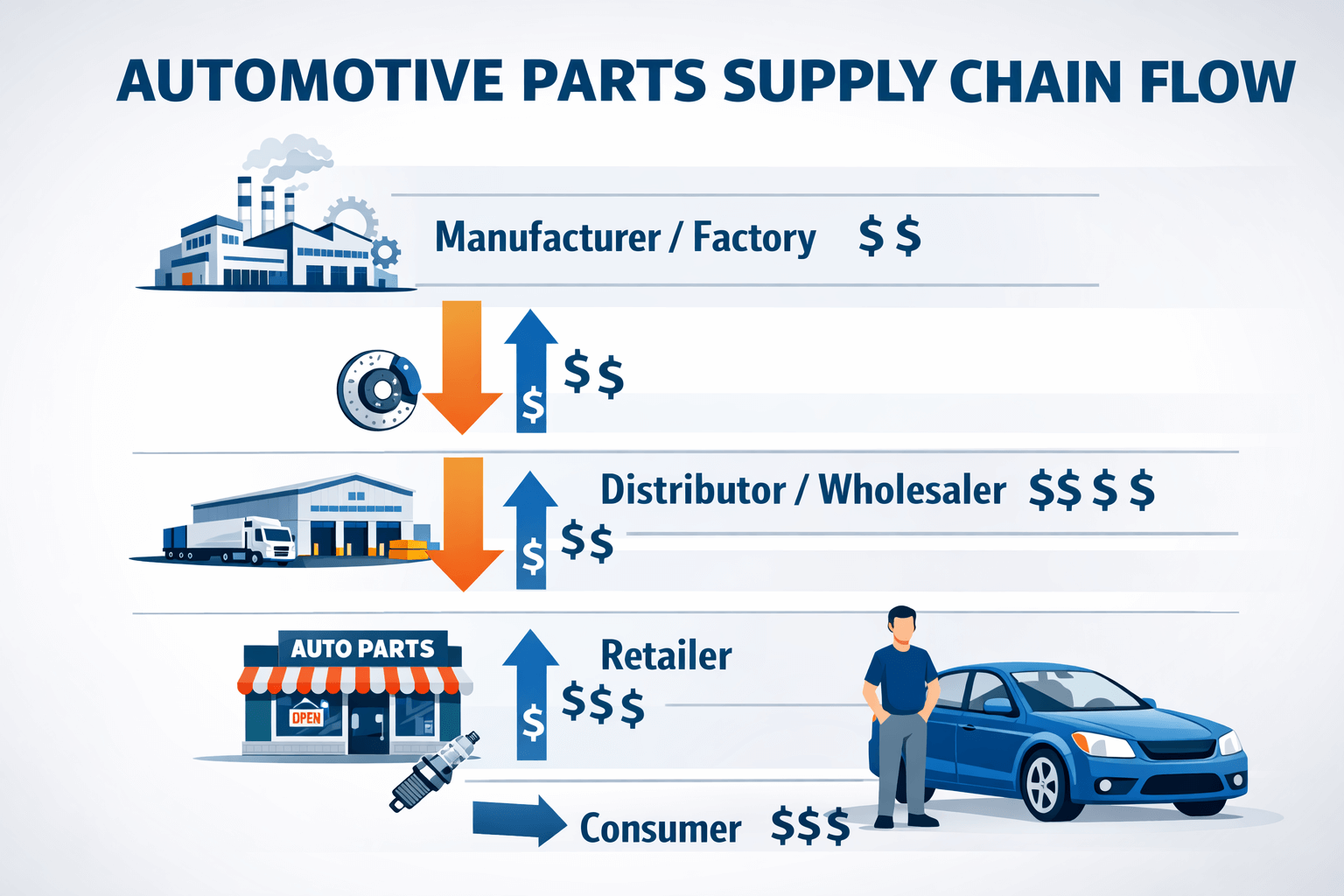
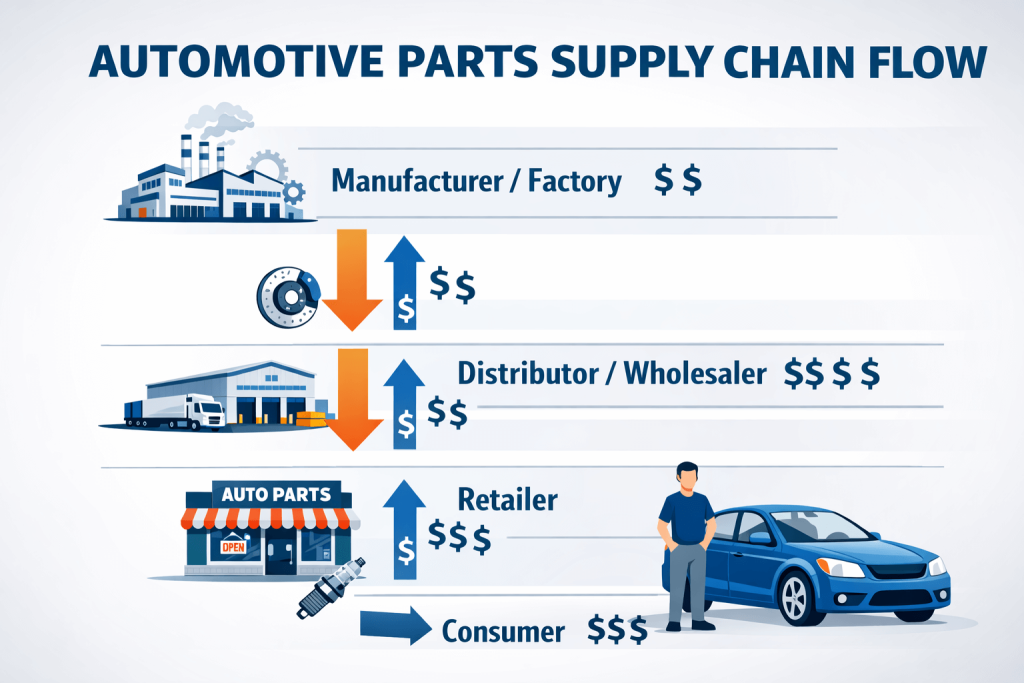
The Traditional Supply Chain Model
Tier 1 Structure:
- Manufacturer/OEM Supplier → Produces the part (e.g., Denso makes alternators)
- Distributor/Wholesaler → Buys in massive bulk, warehouses inventory
- Retailer → Auto parts stores (AutoZone, O’Reilly, NAPA) or dealership parts departments
- Consumer → You, the end user
Each level adds markup, but each also provides value: warehousing, regional distribution, customer service, warranty processing, and returns handling.
Why Manufacturers Prefer This System
Economies of Scale: Manufacturing plants produce parts in runs of thousands or millions. They’re optimized for bulk orders, not individual units.
Logistics Efficiency: Shipping one pallet with 200 brake pad sets to a distributor is far more cost-effective than shipping 200 individual packages to consumers.
Risk Management: Distributors handle returns, defects, and customer complaints. Manufacturers avoid the overhead of retail customer service.
Market Coverage: A network of distributors and retailers reaches every geography without the manufacturer needing retail infrastructure in every city.
OEM vs. Aftermarket: Understanding Your Options
Before we go further, let’s clarify the two main categories of car parts—because this affects where you can buy them.
OEM (Original Equipment Manufacturer) Parts
These are made by the company that supplied parts to the vehicle manufacturer. When you buy a “genuine Honda part” from a Honda dealer, you’re getting the exact component (or an identical replacement) that was installed at the factory.
Sources:
- Vehicle brand dealerships (Ford dealer, Toyota dealer, etc.)
- OEM supplier websites (sometimes)
- Authorized distributors
Pricing: Highest, typically 20-50% more than aftermarket equivalents
Warranty: Usually backed by the vehicle manufacturer’s warranty terms
Aftermarket Parts
These are manufactured by third-party companies after the vehicle is sold. Brands like Dorman, Moog, ACDelco (for non-GM vehicles), and Walker produce parts designed to fit and function like OEM parts, but aren’t officially made for the original vehicle manufacturer.
Quality Range: From budget-grade to premium (sometimes exceeding OEM quality)
Sources:
- Parts retailers (AutoZone, Advance Auto, RockAuto)
- Online marketplaces (Amazon, eBay)
- Direct from some manufacturers’ websites
Pricing: Generally 30-70% cheaper than OEM
Pros and Cons of Ordering Directly from Manufacturers
Let’s assume you’ve found a way to order directly—either you run a repair business or you’ve discovered a manufacturer with a consumer program. Here’s what you’re actually getting into.
Advantages
1. Lower Prices (Sometimes)
You’re eliminating retailer markup, which can be 30-100% depending on the part. For bulk orders, this creates real savings.
Reality check: Some manufacturers have MAP (Minimum Advertised Price) policies that prevent dealers from undercutting each other, which limits your actual savings.
2. Guaranteed Authenticity
Counterfeit parts are a real problem, especially for popular wear items like brake pads and oil filters. Buying from the source eliminates this risk entirely.
3. Access to Technical Documentation
Manufacturers sometimes provide detailed installation guides, torque specifications, and compatibility data that retailers don’t include.
4. Specialty or Hard-to-Find Parts
For discontinued, specialty, or low-volume parts, going directly to the manufacturer might be your only option.
Disadvantages
1. Minimum Order Requirements
Most manufacturers require MOQs that make no sense for individual consumers. Need one water pump? They’ll sell you 50.
2. Extended Shipping Times
Parts might ship from overseas manufacturing facilities. Expect 2-6 weeks instead of next-day delivery from local retailers.
3. No Easy Returns
Retailers have generous return policies. Manufacturers often require RMA (Return Merchandise Authorization) processes, restocking fees, and proof of defect.
4. You’re Responsible for Fitment
Retailers help you confirm the part fits your vehicle. Manufacturers expect you to know your VIN, engine code, and exact specifications—errors are your problem.
5. No Installation Support
Your local parts store might offer free testing or installation advice. Manufacturers won’t walk you through installation troubleshooting.
6. Warranty Complications
If a part fails, processing warranty claims directly with manufacturers involves more paperwork and longer turnaround than swapping it at a local store.
When Direct Ordering IS Possible: Real Scenarios
Despite the barriers, some situations genuinely allow direct manufacturer purchases.
1. You Own or Operate a Registered Business
If you have:
- A repair shop with an EIN/business license
- A fleet management company
- A parts reselling business
- A performance shop
…most manufacturers will open wholesale accounts. You’ll typically need:
- Federal tax ID or business registration documents
- Commercial address (not a P.O. box or residential)
- Business references or credit check
- Agreement to minimum monthly or annual order volumes
2. Manufacturer Direct-to-Consumer Programs
Some companies have realized the market opportunity. Examples include:
Ford Performance Parts: Sells performance and restoration parts directly through their website to consumers.
Mopar Direct Parts: Chrysler/Dodge/Jeep/Ram’s official parts site allows individual purchases.
GM Genuine Parts: General Motors operates an online store for certain component categories.
Tesla Parts: Offers a direct online ordering system for many Model S, 3, X, and Y components.
These programs are exceptions, not the rule, and typically cover limited catalogs—not every possible part.
3. Performance and Specialty Manufacturers
Smaller companies making aftermarket performance parts often sell direct:
- Suspension manufacturers (Bilstein, Eibach)
- Exhaust systems (Borla, MagnaFlow)
- Engine components (Comp Cams, Edelbrock)
- Brake upgrades (StopTech, Brembo)
They maintain websites with shopping carts and treat individual consumers as customers because their business model depends on enthusiast markets.
4. International Sourcing (With Caution)
Some overseas manufacturers, particularly in Asia, will sell directly to consumers via platforms like Alibaba or direct inquiry. However:
- Risk of counterfeits or substandard quality is high
- Shipping costs and customs duties often eliminate savings
- No warranty support or easy returns
- Potential legal issues with importing certain safety components
This approach is generally not recommended unless you have expertise in import/export and quality verification.
When Direct Ordering Is NOT Possible
1. Major OEM Suppliers Serving Automakers
Companies like:
- Bosch (fuel systems, electronics)
- Denso (HVAC, ignition)
- Continental (tires, sensors)
- ZF (transmissions, steering)
- Magna (various systems)
These massive suppliers focus on B2B relationships with automakers and large distributors. They have zero infrastructure for individual consumer sales and no incentive to build it.
2. Vehicle Brand “Genuine Parts”
Want a genuine Toyota part directly from Toyota Motor Corporation’s parts division? You can’t order from corporate headquarters. Toyota routes all retail parts sales through:
- Dealership parts departments
- Authorized Toyota parts distributors
- Licensed online Toyota parts retailers
Same applies for virtually all major automakers: Honda, Ford, GM, Volkswagen, BMW, Mercedes-Benz, etc.
3. Complex or Safety-Critical Components
Certain parts—especially those requiring programming, calibration, or professional installation—are typically restricted:
- Airbag modules (safety regulations)
- Engine control units (anti-theft programming)
- Transmission control modules
- Hybrid/EV battery packs
- Advanced driver assistance system components
Manufacturers limit distribution to protect consumers and reduce liability.
Best Alternatives to Buying Directly from Manufacturers
If direct ordering isn’t practical, here’s how to get closest to manufacturer pricing while maintaining quality and convenience.
1. Authorized Online Retailers with Manufacturer Relationships
RockAuto.com is the gold standard here. They:
- Source directly from manufacturers and distributors
- Show multiple brand options with manufacturer part numbers
- Offer wholesale-level pricing with modest markup
- Ship from regional warehouses (faster delivery)
- Provide detailed fitment data by VIN
CarParts.com, 1A Auto, and FCP Euro (for European vehicles) operate similarly.
Why this works: You’re essentially accessing distributor pricing that’s one step from the manufacturer, often 30-50% below local retail.
2. Dealership Parts Departments (For OEM)
Yes, dealers are typically the most expensive option—but many people don’t realize:
You can negotiate. Parts departments have margin to discount, especially on high-dollar items. Ask politely for “your best price” or mention a cheaper online quote.
OEM parts from dealers come with:
- Perfect fitment guarantee
- Full warranty backed by the automaker
- Expert parts counter staff who can verify compatibility
- Same-day or next-day availability for common parts
For critical repairs or parts under vehicle warranty, the premium is often worth it.
3. Wholesale Clubs and Membership Programs
Costco Auto Program: Partners with service centers offering discounted parts (though limited selection).
NAPA AutoCare / Carquest Professional: If you develop a relationship with a local shop that’s part of these networks, they can sometimes order at professional pricing on your behalf.
AAA discounts: Members get 5-10% off at many parts retailers.
4. Local Independent Distributors
Every region has independent auto parts distributors (often called “jobbers”) who supply local repair shops.
Pro tip: If you’re friendly with a mechanic or body shop owner, ask if they’d be willing to order a part for you at their wholesale cost plus a small markup. Many shops will do this as a courtesy, especially for repeat customers.
5. Manufacturer Rebate and Coupon Programs
Many parts manufacturers (Bosch, Monroe, Motorcraft, ACDelco) offer mail-in rebates or downloadable coupons that retailers accept. These effectively bring you closer to wholesale pricing.
Check manufacturer websites before making major parts purchases.
6. Auto Salvage Yards for OEM Used Parts
For non-wear items (body panels, interior trim, electronic modules), salvage yards source genuine OEM parts from wrecked vehicles at 50-80% off new prices.
LKQ Pick Your Part, Pull-A-Part, and regional yards often have online inventories now.
Frequently Asked Questions
Can I use my VIN to order parts directly from the manufacturer?
Your VIN identifies your exact vehicle specifications, which helps ensure correct fitment. However, having a VIN doesn’t grant you access to manufacturer ordering systems—those are restricted to business accounts. Retailers and dealers use VIN lookup tools connected to manufacturer databases, which is how they verify parts for you.
Will ordering directly save me money on expensive parts like transmissions or engines?
Unlikely for consumers. Even if you could order directly, manufacturers charge distributors rates that already factor in volume discounts you can’t match as an individual. For large components, consider remanufactured units from companies like Jasper or Cardone, which often cost 40-60% less than new OEM with comparable warranties.
Are manufacturer-direct websites selling genuine parts or replicas?
Official manufacturer websites (like Mopar Direct, Ford Performance, GM Genuine Parts) sell 100% genuine parts. However, be cautious of sites claiming to be manufacturer-direct. Verify you’re on the legitimate domain and look for SSL security, business registration info, and customer reviews.
What if the manufacturer says “contact your local dealer”?
This is standard. It means they don’t have consumer-facing sales infrastructure and rely on their dealer/distributor network. It’s not a brush-off—it’s simply how their business model operates.
Can I order parts from overseas manufacturers to save money?
Technically yes, but the practical challenges are significant:
- International shipping costs often exceed savings
- Customs duties and import taxes apply
- No local warranty service
- Long delivery times (4-8 weeks)
- Quality verification is your responsibility
- Potential safety and legal compliance issues
This approach only makes sense for rare or discontinued parts unavailable domestically.
Do I need a business license to buy parts wholesale?
From most manufacturers and distributors, yes. They require an EIN (Employer Identification Number), sales tax permit, and commercial address. Some online wholesalers are more lenient, but legitimate volume wholesalers enforce these requirements strictly.
What about Amazon or eBay—am I getting genuine manufacturer parts?
Sometimes. Many legitimate distributors and retailers sell through these platforms. However:
Red flags for counterfeits:
- Price far below market (40%+ under typical retail)
- Seller based overseas with no brand authorization
- Packaging looks off (poor printing, missing holograms)
- Listings lack manufacturer part numbers
- No warranty information
To stay safe:
- Buy from sellers with thousands of positive reviews and long history
- Verify the seller is an “authorized retailer” if possible
- Compare manufacturer part numbers exactly
- Be suspicious of “too good to be true” pricing
How to Avoid Counterfeit Parts: Insider Tips
Counterfeit auto parts are a multi-billion dollar problem. Here’s how professionals verify authenticity:
1. Check Manufacturer Part Numbers
Every legitimate part has a unique manufacturer part number. Cross-reference this with the manufacturer’s official catalog or website. Counterfeits often have slight variations or missing digits.
2. Examine Packaging Quality
Genuine parts have professional packaging with:
- Clear, crisp printing (no blurry text or colors)
- Security features (holograms, QR codes, tamper-evident seals)
- Manufacturer contact information and website
- Proper regulatory markings (DOT, SAE, ISO certifications)
3. Verify Seller Authorization
Most major manufacturers maintain lists of authorized distributors on their websites. If you’re buying from a new source, verify they’re officially authorized.
4. Compare Weight and Build Quality
Counterfeit parts often use cheaper materials. If something feels surprisingly light or looks crudely finished compared to the part you’re replacing, it’s suspect.
5. Use Manufacturer Authentication Tools
Some brands (especially for performance or safety parts) offer QR codes or serial numbers you can verify on their website.
6. Buy Safety-Critical Parts from Known Sources
For brake components, airbags, suspension parts, and steering components, the risk isn’t worth potential savings from unknown sellers. Stick to established retailers or dealerships.
Making the Smart Choice: Decision Framework
Use this simple framework to decide where to buy your parts:
Choose OEM from Dealership when:
- Part is under vehicle warranty
- You need guaranteed fitment and manufacturer backing
- It’s a safety-critical or complex component requiring calibration
- You value convenience and local support over cost savings
Choose Authorized Online Retailers when:
- You want balance of price, quality, and convenience
- You’re comfortable with basic DIY research and installation
- You can wait 2-5 days for shipping
- You want multiple brand options (OEM, premium aftermarket, budget aftermarket)
Attempt Direct Manufacturer Purchase when:
- You operate a legitimate automotive business
- You’re buying specialty performance parts
- The manufacturer specifically offers consumer sales programs
- You need discontinued or rare components
Consider Salvage/Used OEM when:
- The part is non-wear (not brakes, suspension bushings, etc.)
- You need expensive body panels or trim pieces
- You’re working on an older vehicle where new parts are costly
Avoid:
- Unknown overseas sellers with suspiciously low prices
- Sellers who can’t provide manufacturer part numbers
- Deals that seem too good to be true (they usually are)
Conclusion:
The automotive parts industry is built on a distribution model that rarely allows individual consumers to buy directly from manufacturers—and for most purchases, that’s actually fine. The established supply chain provides value through local availability, easier returns, installation support, and competitive pricing that’s already close to wholesale for savvy shoppers.