
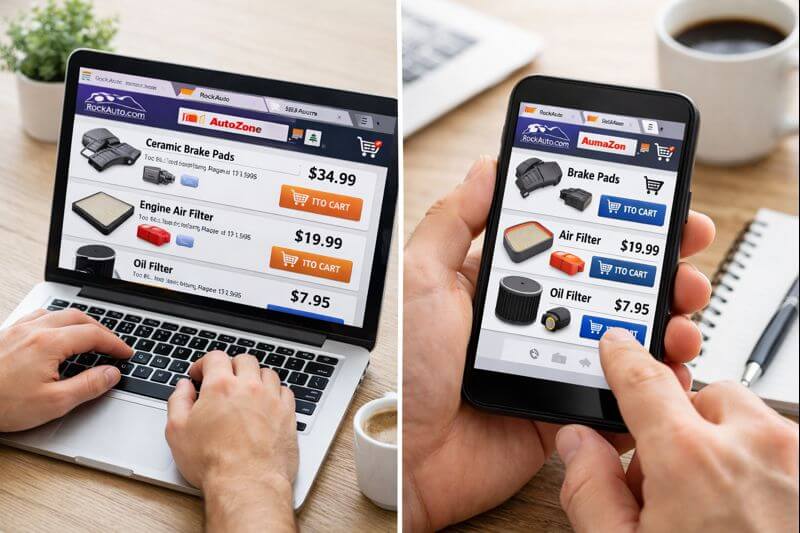
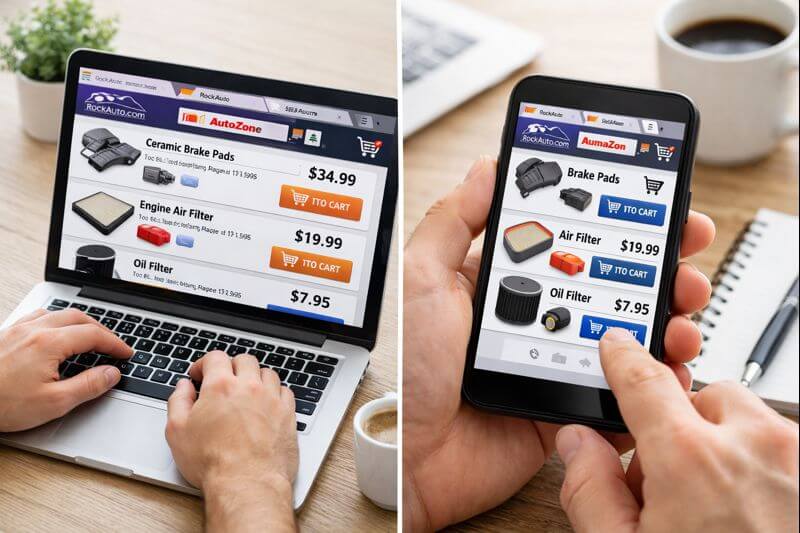
Finding the right car part at the best price used to mean calling around to local shops and hoping you got a fair deal. Now, you can compare dozens of options in minutes—but only if you know where to look and what to watch out for.
I’ve bought everything from brake pads to timing belts online, and I’ve learned the hard way that the lowest price doesn’t always mean the best deal. Between hidden shipping fees, compatibility nightmares, and the occasional counterfeit part, there’s more to smart online shopping than just clicking “buy now” on the cheapest listing.
This guide walks you through the entire process—from identifying exactly which part you need to avoiding scams and calculating the true total cost.
Step 1: Know Exactly What Part You Need
The biggest mistake people make when comparing car part prices is shopping before they know precisely what they’re looking for. Buy the wrong part, and you’ll waste time and money on returns—or worse, install something that doesn’t fit properly.
Use Your VIN Number
Your Vehicle Identification Number (VIN) is the most reliable way to ensure compatibility. This 17-character code tells you the exact year, make, model, trim level, and engine type of your vehicle.
You’ll find your VIN:
- On the driver’s side dashboard (visible through the windshield)
- Inside the driver’s door jamb
- On your vehicle registration and insurance documents
Most reputable online retailers let you enter your VIN to filter parts that fit your specific vehicle. This eliminates guesswork and dramatically reduces the chance of ordering the wrong component.
Get the Part Number
If you’re replacing an existing part, the most foolproof method is using the manufacturer’s part number—usually stamped or printed directly on the component. Take a photo of it before you start shopping.
For OEM (Original Equipment Manufacturer) parts, this number guarantees you’re getting an exact replacement. For aftermarket parts, you can cross-reference this number to find compatible alternatives.
Understand OEM vs Aftermarket Parts
OEM parts are made by the same manufacturer that built your original component. They’re guaranteed to fit and perform exactly like the factory part, but they typically cost more.
Aftermarket parts are made by third-party companies. Quality varies widely—some aftermarket manufacturers produce parts that match or exceed OEM standards, while others cut corners. The benefit is usually a lower price, and sometimes even better performance than stock.
When to choose OEM:
- Critical safety components (brakes, airbags, suspension)
- You have a newer vehicle still under warranty
- You want guaranteed fitment with no surprises
When aftermarket makes sense:
- Older vehicles where OEM parts are overpriced
- Non-critical components like filters, wipers, or interior trim
- You’ve researched a reputable aftermarket brand
Best Websites to Compare Car Part Prices
Different platforms serve different purposes. Here’s where I actually shop, and why.
Dedicated Auto Parts Marketplaces
RockAuto has become my go-to for comparison shopping. They list parts from dozens of manufacturers side-by-side with detailed specs, and their pricing is usually very competitive. The interface shows you OEM and multiple aftermarket options all at once, making it easy to weigh cost versus quality. Shipping can add up since parts often come from different warehouses, but they’re transparent about it upfront.
AutoZone, O’Reilly Auto Parts, and Advance Auto Parts are the big-name retailers. Their websites are straightforward, they often price-match competitors, and you can usually pick up parts the same day at a local store (avoiding shipping costs entirely). Watch for online-only coupons—I’ve saved 20-30% just by checking their homepage before ordering.
PartsGeek and CarParts.com often have competitive pricing, especially on body parts and accessories. Their search tools work well, but I always double-check fitment reviews since their listings can sometimes be less precise than RockAuto.
General Marketplaces
Amazon is convenient if you’re already a Prime member, and their return process is usually painless. The challenge is filtering through low-quality sellers. Stick to parts sold by established brands or “Ships from and sold by Amazon” listings. Read recent reviews carefully—knockoff parts are a real problem here.
eBay Motors can be excellent for OEM parts, especially if you’re hunting for something discontinued or rare. Used OEM parts from salvage yards often cost a fraction of new ones and work perfectly fine for older vehicles. Just verify the seller’s return policy and check their feedback score (aim for 98% or higher with hundreds of transactions).
Manufacturer and Dealer Sites
Sometimes the manufacturer’s website or your local dealership’s parts department has online ordering. OEM parts bought this way cost more, but you’re guaranteed authenticity. I use this option for anything safety-critical or when I need a warranty claim to be straightforward.
Specialty Retailers
If you drive a specific make, specialty sites like FCP Euro (for European cars) or 1A Auto often have better expertise and customer service than general retailers. They understand the quirks of your vehicle and can help you avoid common fitment issues.
How to Compare Prices the Right Way
This is where most people go wrong. They see a $45 part on one site and a $60 part on another, assume the first is cheaper, and hit “buy.” Then they get hit with shipping, handling fees, and discover they needed to pay a core charge.
Calculate the True Total Cost
Always compare these factors:
Base price – The listed part price
Shipping – Can range from free to $30+ depending on size and weight
Taxes – Some states charge sales tax on auto parts, some don’t
Core charges – A deposit you pay for certain parts (alternators, starters, calipers) that’s refunded when you return the old part. If you don’t return it, you’re out that money
Handling fees – Some sellers add these at checkout
I keep a simple spreadsheet when comparing 3-4 retailers. It takes an extra five minutes but has saved me from “cheap” parts that ended up costing more after fees.
Factor in Shipping Speed
A part that costs $10 less but takes two weeks to arrive isn’t a deal if your car is sitting in the driveway and you need it for work. Sometimes paying a bit more for next-day delivery or local pickup makes sense.
Compare Warranties
A lifetime warranty on brake pads means you can exchange them free if they wear prematurely. A 90-day warranty means you’re on your own after three months. OEM parts typically have longer warranties than budget aftermarket options.
Check:
- Warranty length (30 days, 1 year, lifetime)
- What’s covered (defects only, or wear and tear too?)
- Who honors it (manufacturer or retailer)
Understand Return Policies
What if the part doesn’t fit or you order the wrong one? Some sellers charge restocking fees (often 15-25%), while others offer free returns within 30 days.
Read the fine print on:
- Return window (30, 60, 90 days?)
- Who pays return shipping
- Restocking fees
- Whether opened parts can be returned
Amazon and RockAuto are generally hassle-free. Smaller sellers vary widely.
How to Avoid Fake or Low-Quality Parts
Counterfeit auto parts are a bigger problem than most people realize. I once bought what looked like a genuine Bosch oxygen sensor on a too-good-to-be-true deal. The packaging was convincing, but the part failed within a month. Turns out it was a knockoff.
Red Flags for Counterfeit Parts
- Price is dramatically lower than everywhere else (if everyone sells a part for $80-$100, a $35 listing is suspect)
- Vague or missing brand information
- Seller is based overseas with limited feedback
- Product photos look generic or are stock images
- Reviews mention “not genuine” or “fake” repeatedly
Check Seller Reputation
On Amazon and eBay, look at:
- Overall seller rating (98%+ is good)
- Number of transactions (hundreds or thousands, not dozens)
- Recent feedback, especially negative reviews
- How the seller responds to complaints
On dedicated auto parts sites, check third-party reviews on Trustpilot or the Better Business Bureau.
Verify Brand Authenticity
Reputable aftermarket brands include Bosch, Denso, ACDelco, Moog, Monroe, and Wagner. If you’re buying one of these, make sure the seller is an authorized dealer or the listing clearly states it’s genuine.
Some counterfeiters copy packaging almost perfectly. If something feels off—wrong font, poor print quality, misspellings—trust your instinct.
When in Doubt, Go OEM or Trusted Aftermarket
For critical systems—brakes, steering, suspension, airbags—I don’t gamble on unknown brands to save $20. The risk isn’t worth it.
Price Comparison Tips Most Guides Don’t Mention
Here’s what I’ve learned from years of online parts shopping:
Use Browser Extensions for Price Tracking
Install Honey or CamelCamelCamel (for Amazon). These tools track price history and alert you when a part drops to your target price. Auto parts fluctuate more than you’d think—I’ve seen the same air filter range from $12 to $22 over a few months.
Time Your Purchase
Many retailers run monthly or seasonal sales:
- AutoZone and O’Reilly often have 20-25% off site-wide sales
- Memorial Day, Labor Day, and Black Friday bring deep discounts
- End-of-month clearance events
If the part isn’t urgent, waiting a week or two can save significant money.
Check Manufacturer Rebates
Brands like Monroe, Moog, and ACDelco occasionally offer mail-in rebates. You buy the part at full price, submit a form, and get $10-$40 back. It’s annoying paperwork, but for expensive parts it’s worth it.
Cross-Reference International Sellers (Carefully)
Some eBay sellers ship OEM parts from overseas at lower prices because labor and overhead costs are different. I’ve had good luck with highly-rated sellers from Germany for European car parts. Just account for longer shipping times and potential customs issues.
Join Online Forums for Your Car
Enthusiast communities (Reddit, model-specific forums) often share group buys, vendor discount codes, and warnings about sketchy sellers. They’ve also helped me identify which aftermarket brands are worth buying and which to avoid.
Call Local Shops for Price Matching
Some independent mechanics will price-match online retailers if you’re having them install the part. They make money on labor, so they’re often willing to order the part you found online at the same price to keep your business.
Frequently Asked Questions
Is aftermarket always cheaper than OEM?
Usually, but not always. For common parts like filters and brake pads, aftermarket is typically 20-50% less. But for complex electronics or specialized components, aftermarket options can sometimes cost the same or more than OEM—especially if you factor in shorter warranties.
Are used OEM parts worth buying?
It depends on the part and your vehicle’s age. For a 15-year-old car, a used OEM alternator from a salvage yard with 60k miles is often a better deal than a cheap new aftermarket one. For safety components or anything with wear items (turbos, transmissions), I’d stick with new. Always ask about the part’s mileage and whether there’s any warranty.
Can I trust Amazon or eBay for car parts?
Yes, but be selective. On Amazon, buy from established brands or “Sold by Amazon” listings. On eBay, stick to sellers with 98%+ feedback and hundreds of transactions. Avoid listings with stock photos and vague descriptions. Both platforms have strong buyer protection, so if you get a bad part, you can usually return it without too much hassle.
Should I buy the cheapest part I find?
Not automatically. The cheapest option might have hidden costs (shipping, restocking fees), a short warranty, or questionable quality. I aim for the best value—balancing price, warranty, and brand reputation. Sometimes the mid-priced option is the sweet spot.
How do I know if a part fits my car?
Enter your VIN on the retailer’s website or use their year/make/model selector. Then double-check the part number against your existing component or your vehicle’s service manual. Reading fitment reviews from other buyers with your exact vehicle also helps catch compatibility issues the website might miss.
What if I order the wrong part?
Most major retailers accept returns within 30-90 days, though you might pay return shipping or a restocking fee. Keep parts in their original packaging and save your receipt. This is why I always verify fitment twice before ordering—returns are a hassle even when they’re free.
Conclusion
Comparing car part prices online doesn’t have to be complicated. Start by identifying your exact part using your VIN or part number, then check multiple retailers—not just for the lowest price, but for the total cost including shipping, warranties, and return policies. Avoid deals that seem too good to be true, verify seller reputation, and don’t cut corners on safety-critical components. Use browser tools to track prices and time your purchases around sales events. The goal isn’t finding the absolute cheapest part—it’s finding the best value that gets you a quality component at a fair price. Shop smart, and you’ll save money without the headaches.
Compare car part prices online like a pro. Learn to find the best deals, avoid fakes, check compatibility, and calculate true costs before buying.