
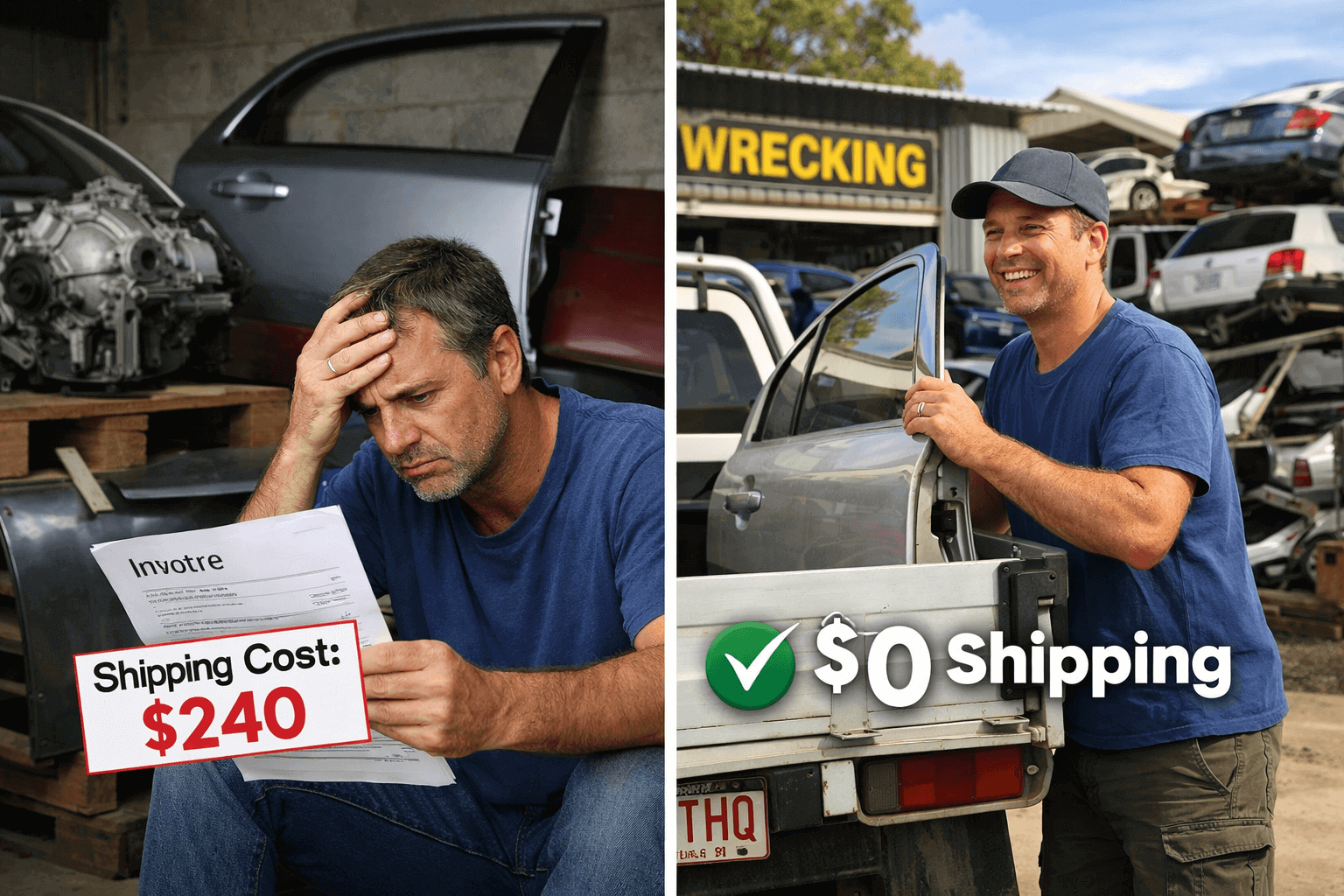
Look, we’ve all been there. You’ve finally tracked down that gearbox or bonnet you need, the price is reasonable, then you see the freight quote and nearly fall over. Shipping car parts around Australia can genuinely cost more than the part itself, especially if you’re ordering heavy gear or getting something sent from interstate.
I’ve spent years helping people source parts from backyard mechanics in Brisbane to workshop owners out in regional Queensland and New South Wales—and the shipping bill is always the bit that stings. But there are proper ways to bring those costs down without compromising on getting what you need.
This guide covers the real tactics that work, the traps to avoid, and how to think about freight like someone who ships car parts every week.
Why Car Parts Shipping Costs So Much in Australia
Before we get into the fixes, it’s worth understanding why you’re copping these charges in the first place.
Distance is the obvious one. Sending a bumper bar from Melbourne to Cairns isn’t cheap. Australia’s big freight companies charge by both weight and distance.
Weight and size matter more than you think.
A door panel might not weigh much, but if it’s bulky, you’re paying for the space it takes up in the truck. Couriers use something called “cubic weight”—basically, if your part is large but light, they calculate the cost based on dimensions, not actual kilos. That’s why sending a bonnet can cost a fortune even though it weighs less than an engine component.
Residential delivery always costs more.
Getting something delivered to your home address costs more than sending it to a business or depot. Freight companies charge extra for tailgate delivery (when they have to lift stuff off the truck) and residential access fees.
Packaging eats into your wallet, too.
If the supplier hasn’t packed it properly, the freight company might refuse it or repack it themselves and slug you for it. Damaged goods on arrival mean returns, which doubles your freight cost.
Buy Locally or Pick Up When You Can
This is the single biggest money-saver, and it’s often overlooked because people jump straight online.
Check your local wreckers first.
Most towns have at least one wrecker or auto recycler. Ring them before you buy online. Yeah, their websites mightn’t be flash, but if they’ve got the part, you can usually drive over, inspect it, and take it home that day. No freight. No waiting. No damaged-in-transit dramas.
I’ve seen people pay $180 freight on a door from Sydney when their local wrecker had the same thing for $120 total, sitting in the yard five Ks away.
Face-to-face pickup with online sellers.
Some eBay sellers and marketplace listings offer pickup. If they’re in your city, it’s worth the drive. I know a bloke in Brisbane who saved $240 on shipping a Commodore tailgate by driving to Ipswich on a Saturday arvo. Took him an hour return, cost him maybe $15 in fuel.
Facebook Marketplace and Gumtree are your mates here. Plenty of parts get listed locally. Filter by your suburb or region and look for “pickup only” listings. You’d be surprised what’s around the corner.
Bundle Your Parts Orders Together
If you need multiple bits—say, a headlight, indicator, and mirror for the same side of the car—order them all from the same supplier at the same time.
One freight charge beats three.
Most couriers and freight companies charge per consignment. Whether it’s one box or three boxes going to the same address on the same day, bundling them into a single shipment is almost always cheaper than separate orders.
Talk to the supplier about combined shipping.
If you’re buying from a wrecker or online parts shop, give them a call. Ask if they can hold one part for a few days while you confirm the others, then send it all together. Most will if you’re upfront about it.
I’ve worked with mechanics who plan their parts orders for the week and submit them in one hit. They’ll save $50–$100 a week on freight just by batching.
Skip Express Shipping Unless You’re Desperate
Express or overnight freight looks tempting when your car’s off the road, but you’re paying a hefty premium for speed.
Standard freight is often half the price.
A gearbox sent express metro-to-metro might cost $180. Same gearbox on standard road freight? Maybe $90–$110. Yeah, it takes an extra two or three days, but if you’re not in a mad rush, that’s real money saved.
Regional areas get hit hardest with express fees.
If you’re outside the major cities, express shipping can double or even triple. Standard freight to regional areas is slower but way more economical, especially for heavy items.
Plan when you can.
If you know you’ll need parts for a job, order early and use standard. I get it—sometimes you need it yesterday. But nine times out of ten, standard is fine.
Ask About Depot-to-Depot or Business Delivery
This one surprises a lot of people, but it can slash your freight costs significantly.
Depot-to-depot delivery is cheaper.
Instead of home delivery, you pick the part up from the courier or freight depot yourself. You’ll save on residential fees and tailgate service. Most depots are in industrial areas—not always convenient, but if it saves you $40–$60, it’s worth the drive.
Deliver to your work address if possible.
If you’ve got a business address or you work somewhere that accepts deliveries, use that instead of your home. Freight companies charge less for commercial addresses because access is easier and there’s usually a forklift or dock.
I know a guy who runs a small panel shop. He tells his mates to get parts sent to the workshop. Saves them money, and he doesn’t mind signing for it.
Choose the Right Type of Freight for the Part
Not all parts should go the same way. Picking the right method makes a big difference.
Small, light parts: use regular couriers.
If you’re ordering something like a fuel cap, mirror, or small bracket, Australia Post or a standard courier (StarTrack, Aramex, Couriers Please) is your best bet. These are priced for parcels, not freight.
Heavy or bulky parts: use road freight carriers.
For engines, gearboxes, diffs, bonnets, doors, or anything over 20–25 kg, you want a freight company like TNT, Toll, or Allied. They’re set up for palletised goods and heavy items. Trying to send a gearbox through a parcel courier will either get rejected or cost you a fortune.
Pallet shipping for multiple heavy parts.
If you’re ordering several heavy items, ask the supplier to palletise them. A single pallet with four doors is cheaper to ship than four separate door shipments. Pallets also protect the parts better in transit.
Understand Cubic Weight and How to Beat It
This is where people get caught out. You order a big, light part—like a bumper or bonnet—and the freight cost is massive because of cubic weight.
Cubic weight formula:
Freight companies calculate it as (length × width × height in cm) ÷ 5000. If that number is higher than the actual weight, you pay for the cubic weight.
Example:
A bonnet might weigh 15 kg, but if it’s 180 cm × 120 cm × 30 cm, the cubic weight is 130 kg. You’re paying to ship 130 kg.
How to reduce it:
- Ask the supplier to pack it more compactly if possible. Sometimes parts can be nested or wrapped more tightly.
- If you’re buying multiple bulky panels, consider asking if they can be stacked together on a pallet. You’re still paying cubic, but you’re not paying it twice.
- Accept pickup or depot delivery to avoid additional residential surcharges on top of the cubic weight.
There’s no magic fix for cubic weight, but being aware of it helps you make smarter decisions about what’s worth shipping and what’s worth picking up.
Compare Quotes from Multiple Freight Providers
Don’t just accept the first shipping quote the supplier gives you.
Use freight comparison sites.
Services like Sendle, Pack & Send, or FreightQuote let you enter your details and compare prices across carriers. Sometimes the difference between couriers for the same item is $30–$50.
Ask if you can arrange your own freight.
Some sellers are cool with this. You buy the part, then you organise a courier or freight company to collect it from them. This works well if you’ve got an account with a freight company or know a cheaper option.
Check if the seller has a freight account.
Businesses that ship regularly often get better rates than you will as a one-off customer. But occasionally, if you’ve got a good relationship with a courier, your rate might beat theirs. Worth asking.
Buy Used Parts to Save on Freight Weight
This sounds odd, but it’s legit.
Used parts are often lighter.
A used engine that’s been stripped of accessories, flywheel, and ancillaries weighs less than a new crate engine. Less weight, less freight cost.
Aftermarket and repro parts can be bulkier.
Reproduction panels sometimes come with extra packaging or are shipped in larger boxes. OEM or genuine used parts from a wrecker are usually packed more tightly.
I’m not saying always go used—sometimes you need new. But if freight cost is the tipping point, a good used part from a local or closer wrecker can be cheaper to buy and cheaper to ship.
Negotiate Freight with the Supplier
Yeah, you can actually do this. Not every time, but it’s worth a crack.
If you’re a repeat customer, ask for a discount.
Wreckers and parts suppliers have some wiggle room, especially on freight. If you’re ordering from the same place regularly, they might cut you a deal or absorb some of the cost.
Bulk orders give you leverage.
Ordering $800 worth of parts? Ask them to throw in free or discounted shipping. The worst they can say is no.
Be upfront about competing quotes.
If another supplier has the same part cheaper including freight, mention it. Sometimes they’ll match or beat it to keep your business.
Avoid Returns and Damaged Goods (They Double Your Freight Cost)
Nothing’s worse than paying freight twice because the part was wrong or arrived smashed.
Confirm fitment before you order.
Use your VIN, call the supplier, and double-check part numbers. Returning a wrong part means you’re paying return freight plus the new freight. That’s $100+ down the drain.
Ask about the packaging.
If you’re buying something fragile (like a windscreen or headlight), ask how it’ll be packed. If they say “bubble wrap and a box,” that mightn’t be enough. You want proper packaging—foam, corner protectors, double-boxed if it’s glass.
Inspect on delivery if possible.
If you’re home when the freight arrives and it’s a high-value or fragile part, check it before signing. If it’s damaged, note it on the delivery docket. Makes the insurance claim way easier.
Consider Freight Insurance for Expensive Parts
If you’re shipping something valuable—like a $2,000 engine or a rare panel—consider insurance.
Most freight quotes don’t include full insurance.
Standard cover is usually capped at $100 or based on weight (like $2 per kg). If you’re shipping a $1,500 gearbox and it gets damaged, you’re only getting a fraction back.
Ask for transit insurance.
It’s usually an extra $10–$30, depending on the value, but it’s worth it for peace of mind. If the freight company writes off your part, you’re covered for the full replacement cost.
Metro vs Regional: Know What You’re In For
If you’re in Sydney, Melbourne, or Brisbane, freight is easier and cheaper. If you’re regional or remote, it’s a different game.
Metro-to-metro is the cheapest.
Sydney to Melbourne, Brisbane to Gold Coast—these are high-volume routes. Freight companies run them daily, so costs are lower.
Regional adds time and money.
Sending something to Bundaberg, Tamworth, or Broken Hill costs more and takes longer. You’ll often pay a regional surcharge, and delivery might be weekly, not daily.
Remote areas can be brutal.
Far North Queensland, outback NSW, NT—freight here can be eye-watering. Sometimes it’s cheaper to drive to the nearest major town and collect from a depot there.
Look into regional freight specialists.
Some companies focus on rural and regional delivery and have better rates than the big couriers for those areas.
Use Free Shipping Offers (But Read the Fine Print)
Some online parts retailers offer free shipping over a certain amount, like $100 or $200.
This can be a great deal or a trap.
Free shipping usually means standard metro delivery. If you’re regional, they’ll slug you with a surcharge at checkout. Always check the terms before you load up your cart.
Sometimes it’s worth adding a cheap part to hit the free shipping threshold.
If you’re at $95 and free shipping kicks in at $100, chuck in some oil or a filter. You’re spending $5 to save $20–$30 in freight.
Practical Tips and Cost-Saving Strategies
Here’s a quick-reference list of tactics that work:
- Always call local wreckers first—pickup beats freight every time
- Order multiple parts together to avoid multiple freight charges
- Use standard freight instead of express unless it’s urgent
- Deliver to a business address or depot to save on residential fees
- Compare freight quotes across couriers before confirming
- Ask the supplier to palletise heavy items for better rates
- Check cubic weight for large, light parts before ordering
- Plan ahead so you’re not forced into expensive express options
- Negotiate freight costs if you’re a regular customer or placing a big order
- Confirm part fitment to avoid costly returns and double freight
- Use freight insurance on expensive or fragile parts
- Take advantage of free shipping thresholds when it makes sense
FAQ: Real Questions from Car Parts Buyers
How much does it cost to ship a gearbox in Australia?
Depends on distance and weight, but expect $90–$180 for standard metro-to-metro freight. Interstate or regional can be $150–$300+. Depot-to-depot is cheapest; residential delivery with tailgate service costs more. Always get a quote before committing.
Is it cheaper to buy car parts locally or order online?
Usually local is cheaper once you factor in freight. A $150 part online might cost $200 delivered, while your local wrecker has it for $180 with no shipping. Online makes sense for rare parts or if local options are way more expensive.
What’s the cheapest way to ship heavy car parts like engines?
Palletised road freight with depot-to-depot delivery. Costs roughly $150–$350 depending on distance. Avoid residential delivery and tailgate service if you can arrange a forklift or ute to collect it yourself.
Why is shipping to regional areas so expensive?
Lower delivery frequency, longer distances, and fewer freight options. Couriers charge regional surcharges because they can’t consolidate as many deliveries per trip. Sometimes it’s worth driving to the nearest major city’s depot.
Can I negotiate shipping costs with car parts suppliers?
Yep, especially if you’re a repeat customer or placing a large order. Ask if they can discount or include freight. Wreckers and smaller suppliers often have more flexibility than big online retailers.
What’s cubic weight and how does it affect my shipping cost?
Cubic weight is a calculation based on the size of the package, not the actual weight. If your part is big but light (like a bonnet), you’ll pay based on the space it takes up in the truck. Formula: (L × W × H in cm) ÷ 5000. If that’s higher than the actual weight, you pay the cubic rate.
Should I use Australia Post or a freight company for car parts?
Australia Post or standard couriers (StarTrack, Aramex) are fine for small, light parts under 5 kg. Anything heavy or bulky needs a freight carrier like Toll or TNT. Using the wrong one will either cost heaps or get rejected.
How do I avoid paying for damaged parts and return freight?
Confirm fitment before ordering, ask about packaging quality, and inspect parts on delivery if possible. For expensive items, pay for transit insurance. Note any damage on the delivery docket before signing.
Is depot-to-depot shipping worth the hassle?
If it saves you $40–$80, absolutely. Most depots are open during business hours, and the drive is usually under 30 minutes in metro areas. Regional depots might be further, but the savings can be even bigger.
What’s the best way to ship multiple car parts at once?
Bundle them in one order with the same supplier. Ask them to pack everything together or palletise it. One freight charge for multiple parts is always cheaper than separate shipments.
Your Practical Takeaway Checklist
Before you order your next car part, run through this:
- Checked local wreckers and pickup options first
- Confirmed the part number and fitment to avoid returns
- Bundled multiple parts into one order where possible
- Compared freight quotes from different couriers
- Chosen standard freight over express if time allows
- Asked about depot-to-depot or business delivery options
- Confirmed packaging is adequate for the part type
- Considered freight insurance for high-value items
- Checked if free shipping applies (and read the fine print)
- Negotiated freight costs if ordering bulk or from a regular supplier