
If you’ve decided to sell your non-running, damaged, or totaled vehicle for parts, you’re probably wondering what actually happens after it leaves your driveway. Will someone else end up driving it? Are you still liable if it’s involved in an accident? Is the process environmentally responsible?
Here’s the straightforward answer: When you sell a car for parts to a legitimate auto salvage yard or recycler, your vehicle is systematically dismantled, useful components are resold, hazardous materials are safely removed, and the remaining metal is crushed and recycled. Once proper title transfer is complete, your legal responsibility ends.
This guide walks you through every step of the junk car process, explains the legal protections that matter, and reveals what really happens behind the gates of auto recycling facilities. Understanding this process gives you confidence that you’re making a safe, legal, and environmentally sound decision.
The First 24–72 Hours: Pickup, Paperwork, and Title Transfer
Vehicle Collection
After you accept an offer from an auto salvage yard, the buyer typically arranges free towing within one to three business days. The driver arrives with a flatbed or tow truck, verifies the vehicle matches the VIN you provided, and loads your car for transport to the recycling facility.
Some sellers choose to drive or tow their vehicle directly to the salvage yard, especially if it’s still partially operational. Either way, this is your last interaction with the car.
Critical Documentation
This is the most important part of selling a car for parts: proper title transfer protects you from future liability.
When the tow driver or yard representative arrives, you’ll complete several documents:
- Vehicle title signed over to the buyer – This legally transfers ownership and is non-negotiable for legitimate businesses
- Bill of sale – Records the transaction date, sale price, and odometer reading
- Release of liability form – Your state’s DMV form confirming you no longer own the vehicle
The salvage yard records your car’s VIN immediately upon arrival. Reputable auto recyclers report this information to the National Motor Vehicle Title Information System (NMVTIS), creating a permanent record that your vehicle has entered the salvage stream.
What You Must Do Next
Within 5–10 days (check your state’s specific deadline), you need to:
- Notify your DMV that you’ve sold the vehicle – Most states have online portals for this
- Cancel your registration – Prevents future registration fees from accumulating
- Cancel or transfer your insurance – Why pay for coverage on a car you don’t own?
- Remove the license plates (required in most states) – Turn these in to the DMV or keep them for transfer
Skipping these steps can leave you vulnerable to parking tickets, toll violations, or even criminal liability if someone illegally uses your vehicle or VIN before the salvage yard processes it.
Days 1–7: Intake, Inspection, and Inventory Assessment
Professional Evaluation Process
Once your car arrives at the auto salvage yard, it enters a formal intake process. Trained technicians conduct a systematic assessment to determine which components have resale value.
What they’re looking for:
- Mechanical parts – Engine blocks, transmissions, alternators, starters, radiators, and catalytic converters in working condition
- Body panels and glass – Undamaged doors, hoods, fenders, bumpers, headlights, and windshields
- Interior components – Seats, dashboards, steering wheels, electronics, and trim pieces
- Wheels and tires – Rims and tires with adequate tread depth
- Electronics – GPS units, infotainment systems, control modules, and sensors
Modern salvage yards use sophisticated inventory management systems. Each salvageable part receives a unique identifier linked to your car’s VIN, make, model, year, and mileage. This data feeds into online parts marketplaces where repair shops and individual buyers search for specific components.
Quality Control Standards
Legitimate auto recyclers follow industry standards set by organizations like the Automotive Recyclers Association (ARA). Before any part is listed for sale, it undergoes:
- Visual inspection for cracks, corrosion, or damage
- Functional testing when possible (starters are bench-tested, electronics are checked for proper operation)
- Cleaning and preparation to make parts retail-ready
Parts that fail quality checks are marked for scrap metal recycling rather than resale.
Week 1–2: Dismantling and Hazardous Material Removal
Environmental Compliance is Mandatory
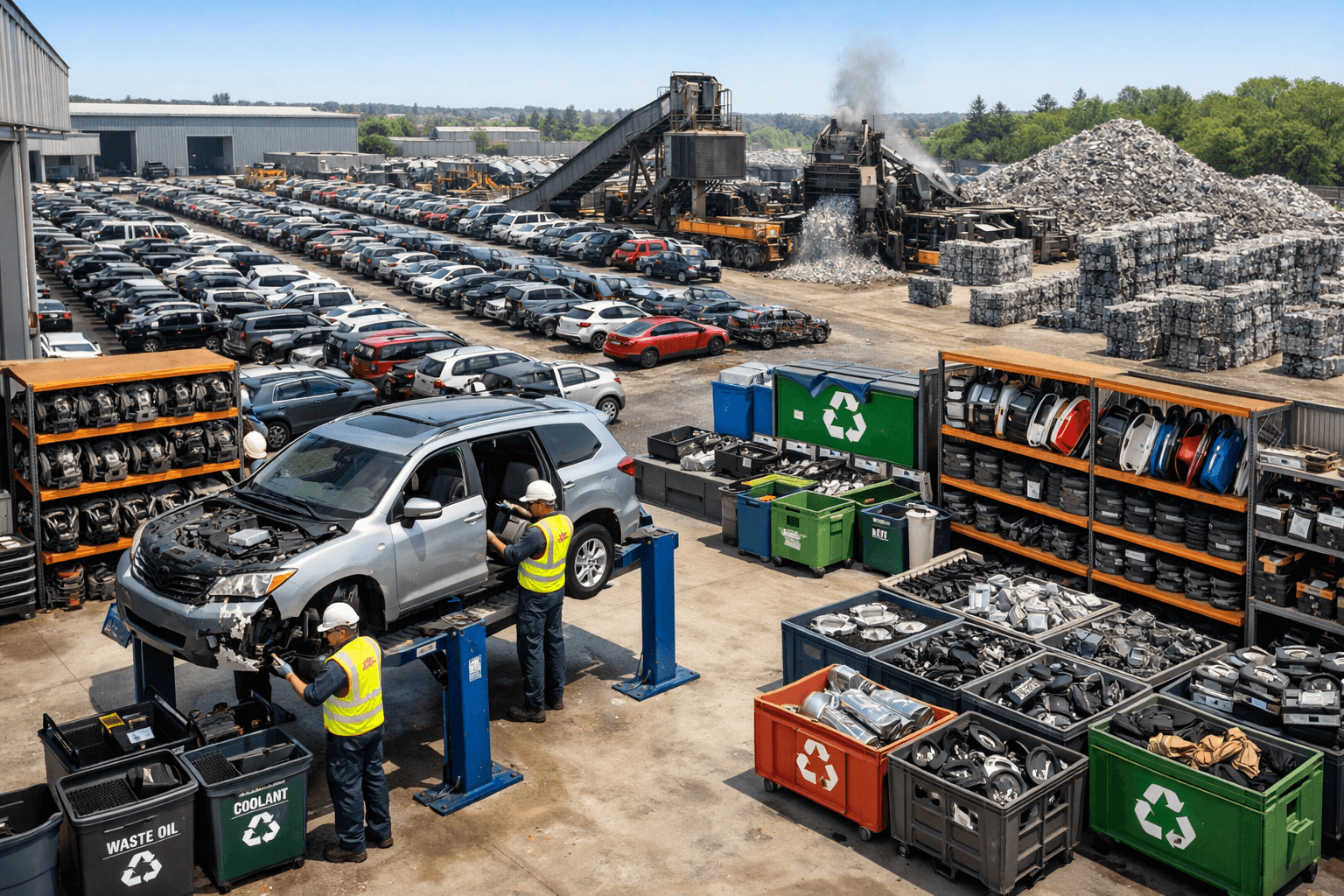
Before a single bolt is removed, environmental regulations require the complete draining and proper disposal of all hazardous fluids. This isn’t optional—it’s federal and state law under the Resource Conservation and Recovery Act (RCRA) and Clean Air Act.
Fluids removed and recycled:
- Motor oil – Sent to re-refineries or burned as industrial fuel
- Transmission fluid – Recycled or disposed of as hazardous waste
- Coolant (antifreeze) – Recycled or neutralized before disposal
- Brake fluid – Collected and disposed of properly
- Gasoline and diesel – Drained and sent to fuel recyclers
- Air conditioning refrigerant – Captured using EPA-certified equipment (required by law to prevent ozone depletion)
The vehicle’s battery is removed and sent to battery recyclers, where 99% of its materials—lead, plastic, and sulfuric acid—are recovered and reused. Car batteries are one of the most recycled consumer products in the United States.
The Dismantling Process
With fluids safely removed, trained dismantlers systematically remove valuable components. This is skilled work requiring automotive knowledge and specialized tools.
High-value parts removed first:
- Engines and transmissions (often sold as complete assemblies)
- Catalytic converters (contain precious metals like platinum and palladium)
- Electronic control modules and computers
- Body panels and structural components
Lower-value but commonly needed parts:
- Mirrors, door handles, and interior switches
- Suspension components
- Exhaust systems
- Wiring harnesses
Each part is tagged, photographed, and entered into the inventory system with condition notes and compatibility information.
Week 2–4: Parts Sales and Shell Preparation
The Secondary Market
Once cataloged, your car’s parts become available to:
- Independent repair shops looking for affordable OEM replacements
- DIY mechanics fixing their own vehicles
- Body shops needing collision repair components
- Classic car enthusiasts seeking discontinued parts
Quality salvage parts typically cost 30–70% less than new dealer parts while maintaining the same manufacturer specifications. This creates genuine value for consumers while extending the useful life of automotive components.
Parts may sell within days or sit in inventory for months, depending on the vehicle’s make, model, and popularity.
What Happens to Unsold Parts
Not every component finds a buyer. After a reasonable inventory period (usually 90–180 days), slower-moving parts are either:
- Transferred to wholesale parts brokers
- Scrapped for metal value
- Sold in bulk to smaller salvage operations
This ensures the facility doesn’t become overwhelmed with aging inventory.
The Final Stage: Crushing, Shredding, and Metal Recycling
From Car to Cube
Once all marketable parts have been removed, what remains is an empty shell called a “hulk.” This stripped frame contains primarily steel, but also aluminum, copper, and small amounts of plastic and rubber.
The crushing process:
- Car crusher compacts the hulk into a dense cube or flattened rectangle, typically reducing the volume by 80%
- Transport to a metal shredder – Industrial shredders break the crushed car into fist-sized pieces in seconds
- Magnetic separation – Powerful magnets extract ferrous metals (steel and iron)
- Eddy current separation – Removes non-ferrous metals like aluminum and copper
- Manual and automated sorting – Remaining materials are categorized for appropriate recycling streams
Where Your Car’s Metal Goes
The recovered steel is sold to steel mills, where it’s melted down and reformed into new products—potentially including new car parts, construction materials, appliances, or infrastructure components.
The numbers are impressive:
- Approximately 12 million vehicles are recycled in the United States each year
- About 86% of a vehicle’s materials can be recycled or reused
- Recycling steel from one car saves enough energy to power a home for 6 months
Your old car’s steel might end up in a new vehicle rolling off an assembly line within 90 days of being scrapped.
Legal and Ownership Implications: When Does Your Responsibility Actually End?
The Title Transfer Timeline
Your legal liability for the vehicle ends the moment the title is properly transferred and you’ve filed a release of liability with your state’s DMV. However, there’s often a gap between when you hand over the title and when government databases update.
Why this matters:
If your car is somehow used illegally during this gap period, you have documentation proving you no longer own it. The signed bill of sale, title transfer paperwork, and DMV release form are your protection.
What Happens If You Skip Proper Paperwork
Selling without transferring the title—often called a “skip title” or “floating title”—creates serious problems:
- You remain the legal owner in government records
- Parking tickets and toll violations may be sent to your address
- If the car is abandoned, you could be responsible for towing and storage fees
- If used in a crime, police may contact you as the registered owner
- Your credit could be damaged if fees go to collections
Legitimate salvage yards will never complete a transaction without proper title transfer. If a buyer offers to pay extra to skip this step, they’re operating illegally and you should walk away.
VIN Tracking and the Permanent Record
Once a vehicle is processed by a licensed auto recycler, its VIN is marked in national databases as “salvaged” or “recycled.” This prevents someone from:
- Re-registering it for road use without proper salvage title procedures
- Using the VIN to create fraudulent title documents
- Selling it as a complete, roadworthy vehicle
This VIN tracking system protects consumers from buying dangerous rebuilt wrecks disguised as clean-title vehicles.
Environmental Impact: Why Car Recycling Matters
The Sustainability Angle
Automotive recycling is one of the largest recycling industries in North America, and for good reason—manufacturing new metal from ore is extraordinarily energy-intensive.
Environmental benefits of vehicle recycling:
- Energy savings – Recycling steel uses 74% less energy than producing it from raw iron ore
- CO2 reduction – Each recycled car prevents approximately 3,000 pounds of iron ore, 1,400 pounds of coal, and 120 pounds of limestone from being mined
- Hazardous waste diversion – Proper fluid disposal prevents soil and groundwater contamination
- Landfill conservation – Without auto recycling, junked cars would consume massive landfill space
Regulatory Oversight
Auto recyclers operate under strict environmental regulations enforced by the EPA, state environmental agencies, and local authorities. Facilities must:
- Maintain permits for hazardous waste handling
- Document fluid disposal through certified contractors
- Prevent stormwater contamination from outdoor vehicle storage
- Submit to periodic inspections and audits
Violations result in fines, operating restrictions, or facility closure. This regulatory framework ensures the car dismantling process protects public health and the environment.
Common Myths and Misconceptions About Selling Cars for Parts
Myth #1: “My Car Will Be Illegally Resold or Driven”
Reality: Licensed salvage yards have no incentive to title and resell your vehicle illegally. The profit margins are far better on selling individual parts and scrap metal. Additionally, the VIN reporting requirements and paper trail make illegal resale extremely risky.
The only exception is vehicles that are relatively new with minimal damage—these might be sold at salvage auction to rebuilders who legally obtain salvage titles. But this is a transparent, regulated process, not a shady backdoor operation.
Myth #2: “I’ll Still Be Liable After the Sale”
Reality: Once you’ve properly transferred the title and filed a release of liability, you are legally protected. The new owner (the salvage yard) assumes all responsibility.
The confusion stems from situations where sellers skip the paperwork. Complete the title transfer, notify your DMV, and keep copies of all documents. You’re fully protected.
Myth #3: “Auto Salvage Yards Are Environmentally Harmful”
Reality: Modern auto recyclers are highly regulated environmental operations. They divert millions of tons of material from landfills, prevent hazardous fluid contamination, and reduce the energy consumption and emissions associated with mining and manufacturing new materials.
Disreputable, unlicensed “backyard” operations do exist and do cause environmental harm—which is exactly why you should verify your buyer is a licensed, insured business operating legally.
Myth #4: “I Could Make More Money Parting It Out Myself”
Reality: While technically true, individual sellers rarely have the space, tools, time, expertise, or buyer network to efficiently part out a vehicle. Most people who try end up with a stripped car hulk sitting in their yard for months, unable to find buyers for remaining parts, and facing disposal costs that wipe out any profit.
Professional salvage yards can profitably pay you for your car because they operate at scale with established buyer networks and efficient processes.
Frequently Asked Questions
Can my car be driven again after I sell it for parts?
Not legally, in most cases. Once a vehicle enters the salvage recycling stream and its VIN is marked as salvaged, it cannot be re-registered for road use without going through your state’s salvage title inspection process. Since cars sold for parts are typically dismantled, there’s nothing left to register. Individual parts may be used to repair other vehicles, but your specific car won’t be driven again.
How long does the entire process take from sale to recycling?
The timeline varies, but typically:
- Pickup: 1–3 days after sale
- Fluid removal and dismantling: 1–2 weeks
- Parts sales: Ongoing for 3–12 months
- Final crushing and metal recycling: 2–6 months
Your involvement ends the day of pickup, but the vehicle’s journey through the recycling system continues for months.
What if my car has no title or a lost title?
Requirements vary by state. Some states allow salvage yards to purchase vehicles without titles using a bonded title process, mechanic’s lien, or parts-only bill of sale. However, you’ll receive significantly less money (often 50% less) because the buyer assumes legal risk and cannot easily resell certain high-value parts. It’s almost always worth requesting a duplicate title from your DMV before selling.
Will I get more money if my car has valuable parts?
Yes. Salvage yards assess your vehicle’s parts value when making an offer. Vehicles with functioning engines, transmissions, or high-demand body panels receive higher offers than completely destroyed vehicles valued only for scrap metal weight.
Is selling my car for parts the same as donating it?
No. When you sell for parts, you receive cash payment. When you donate, the charity either uses the car, sells it at auction, or scraps it, and you receive a tax deduction. The actual vehicle processing may be identical, but the financial and tax implications differ.
Do I need to remove my personal belongings?
Yes, absolutely. Salvage yards are not responsible for items left in vehicles. Remove all personal belongings, thoroughly check the glove box, center console, trunk, under seats, and anywhere else you might have stored items. Once the car leaves your property, retrieving forgotten items is difficult or impossible.
Conclusion:
Selling your car for parts is a straightforward, legal, and environmentally responsible decision when you work with licensed auto recyclers. Your vehicle will be systematically dismantled, usable components will extend the life of other vehicles, hazardous materials will be safely managed, and the remaining metal will be recycled into new products.
Your responsibility ends with proper title transfer and DMV notification—simple steps that protect you from future liability. The salvage yard assumes ownership and all associated responsibilities the moment you sign over the title.
The auto recycling industry processes millions of vehicles annually with rigorous environmental standards, creating a sustainable alternative to landfilling and reducing the environmental impact of automotive manufacturing. You can feel confident that your decision contributes to resource conservation and environmental protection.