
Ordering the wrong car part is one of the most frustrating experiences for vehicle owners and mechanics alike. A mismatched brake pad, an incompatible alternator, or a filter that doesn’t fit can cost you time, money, and unnecessary stress. Whether you’re ordering online through platforms like AutoZone, RockAuto, or from a local parts supplier in Karachi or Lahore, providing accurate vehicle information is the difference between a successful repair and a costly mistake.
This comprehensive guide explains exactly what details you need when ordering automotive parts, where to find this information on your vehicle, and how to verify compatibility before making a purchase. Whether you’re a DIY enthusiast working on your Honda Civic or a professional mechanic sourcing parts for a customer’s Toyota Corolla, this guide will help you order with confidence.
Why Accurate Vehicle Information Matters
Modern vehicles are manufactured with hundreds of variants, even within the same model and year. A 2018 Honda City sold in Pakistan might have different parts than a 2018 Honda City sold in Japan or the United States. The engine size, transmission type, trim level, and even regional assembly differences all affect which parts will fit your vehicle.
Providing incorrect information leads to several problems: delayed repairs while you wait for the correct part, return shipping costs, restocking fees from suppliers, potential installation damage if forcing an incompatible part, and wasted time troubleshooting what should have been a straightforward replacement. Professional mechanics know that taking five extra minutes to verify vehicle details saves hours of frustration later.
Essential Vehicle Details Required for Car Parts Orders
When ordering any automotive part, whether it’s a small component like a spark plug or a major assembly like a transmission, you’ll need to provide these fundamental details:
Vehicle Make:
This is the manufacturer’s brand name—Toyota, Honda, Suzuki, Nissan, Mitsubishi, Hyundai, KIA, Mercedes-Benz, BMW, and so on. The make is usually the easiest piece of information, but be careful with brands that have sub-brands or regional variations.
Model Name:
The specific vehicle line within the manufacturer’s range. Examples include Corolla, Civic, Alto, Cultus, Mehran, Accord, CR-V, or Tucson. Model names can sometimes be confusing, especially with vehicles that share platforms or have been rebadged for different markets.
Year of Manufacture:
The model year is critical because manufacturers often make engineering changes mid-generation. A 2015 and 2016 model might look identical but have completely different brake systems or engine components. In Pakistan and South Asia, always verify the actual manufacturing year, not just the registration year, as there can be delays between production and registration.
Engine Size and Type:
Engine displacement is typically measured in liters or cubic centimeters (cc). Common examples include 1.0L, 1.3L, 1.5L, 1.8L, 2.0L, or expressed as 660cc, 1000cc, 1300cc, 1500cc. The engine type also matters—is it naturally aspirated, turbocharged, or supercharged? Different engine variants require completely different parts for intake systems, exhaust components, and engine internals.
Trim Level or Variant:
This is where many ordering mistakes happen. A Suzuki Cultus VXR has different features and parts compared to a Cultus VXL or base model. In Pakistan, common trim designations include XLi, GLi, XLiM, Aspire, Prosmatec, VX, VXR, S, SR, and many others. These trim levels affect everything from interior components to suspension parts and electrical systems.
Fuel Type:
Whether your vehicle runs on petrol (gasoline), diesel, CNG, hybrid, or electric power makes a significant difference. Fuel system components, injectors, filters, and even engine oil specifications vary based on fuel type.
Transmission Type:
Manual or automatic transmission affects not only transmission-related parts but also clutch components, drive shafts, and even some electrical systems. Some vehicles also come with CVT (Continuously Variable Transmission) or dual-clutch automatic transmissions, each requiring specific parts.
Drive Configuration:
Is your vehicle front-wheel drive (FWD), rear-wheel drive (RWD), or all-wheel/four-wheel drive (AWD/4WD)? This affects suspension components, differential parts, and axle assemblies.
VIN, Chassis Number, and Engine Number Explained
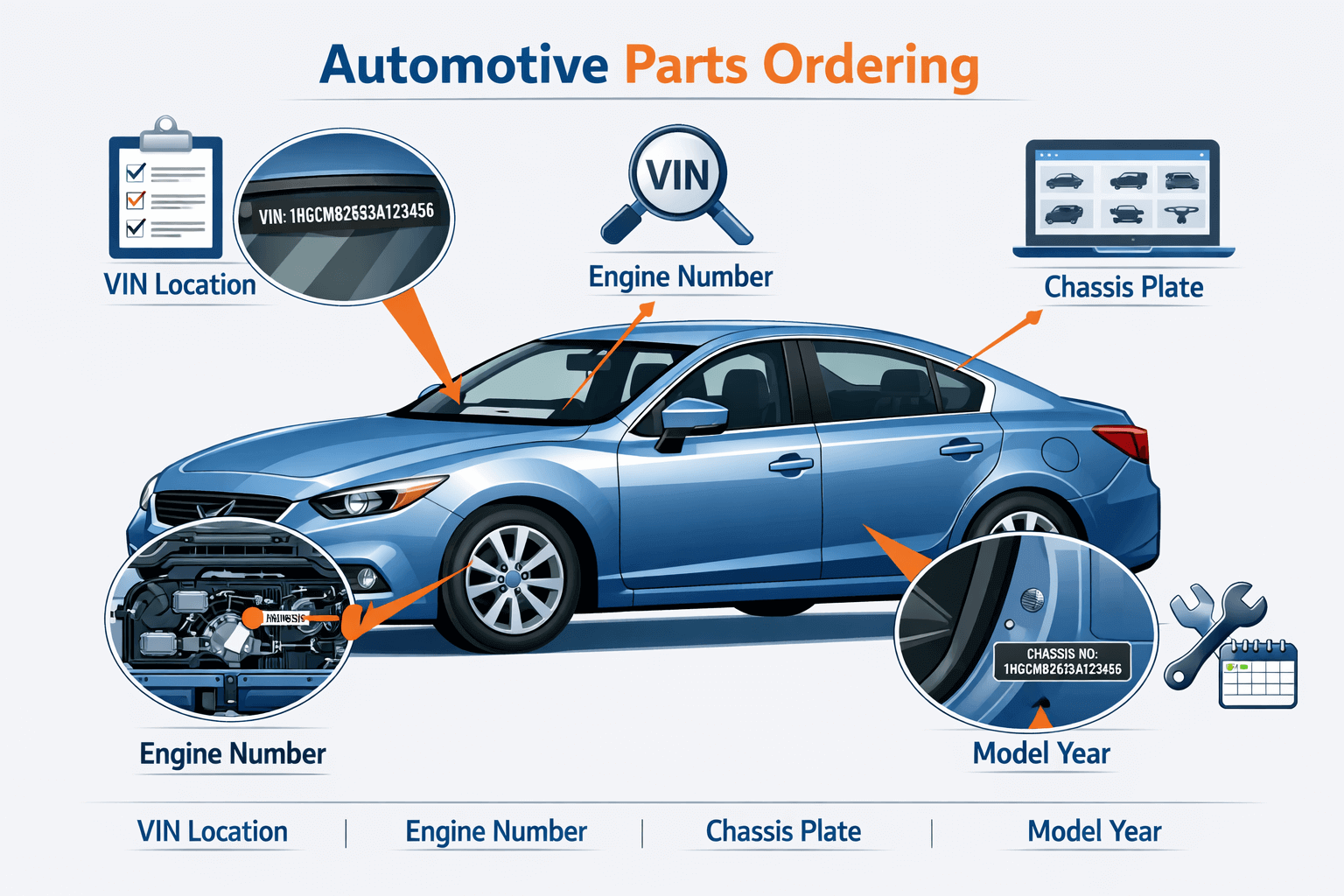
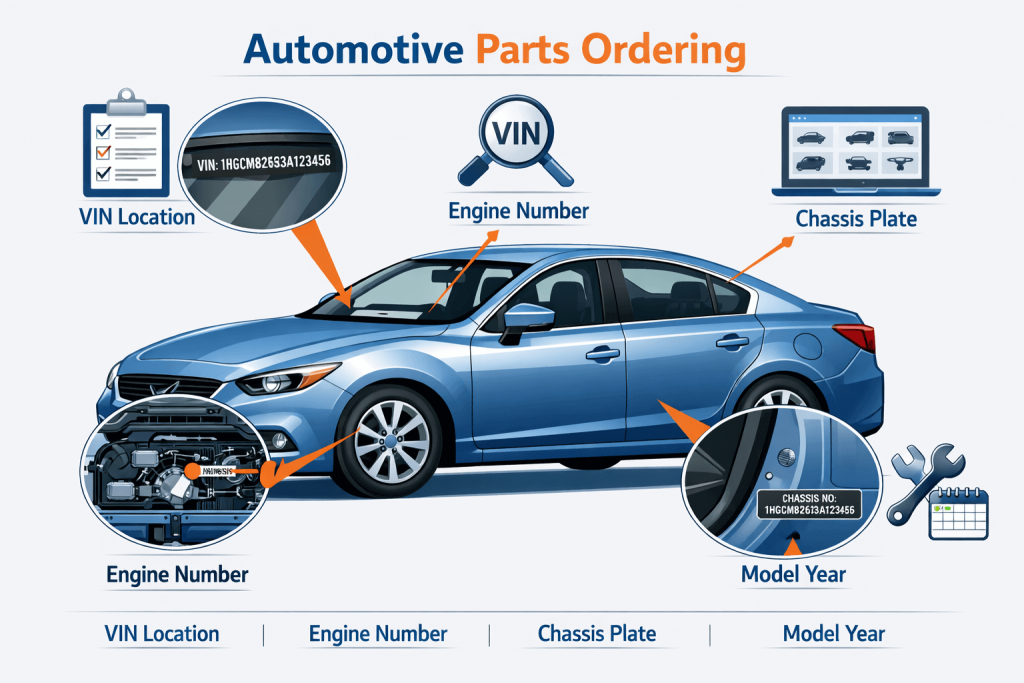
The Vehicle Identification Number (VIN) is the single most accurate way to identify your vehicle and ensure parts compatibility. This unique 17-character code is like your vehicle’s fingerprint—no two vehicles share the same VIN.
Where to Find Your VIN:
Look in multiple locations depending on your vehicle. The VIN is typically stamped on a metal plate on the dashboard, visible through the windshield on the driver’s side. It’s also usually found on a sticker or plate inside the driver’s door jamb. Your vehicle registration documents will also list the VIN. In Pakistan, the registration book (vehicle documents) contains this information clearly.
The VIN contains encoded information about the manufacturing country, manufacturer, vehicle type, engine, model year, assembly plant, and production sequence number. When you provide a VIN to a parts supplier, they can decode it instantly to identify your exact vehicle configuration, including factory-installed options that affect parts compatibility.
Chassis Number:
In South Asian markets, the chassis number is often used interchangeably with VIN, though technically the chassis number is part of the VIN (typically the last 6 digits). The chassis number is stamped directly on the vehicle’s frame or chassis and is also recorded in your vehicle documents. When ordering parts locally in Pakistan, mechanics often ask “gaari ka chassis number kya hai?”
Engine Number:
Separate from the VIN, the engine number is stamped directly on the engine block. This number identifies the specific engine variant installed in your vehicle. The engine number location varies by manufacturer—it might be on the front of the engine block, on the side near the oil filter, or stamped on a flat surface on top of the engine. Your vehicle registration documents also list the engine number.
Why the engine number matters: Even vehicles with the same model and year might have different engine variants installed. For example, a 2016 Toyota Corolla might come with a 1.3L or 1.6L or 1.8L engine. Each requires completely different pistons, gaskets, timing components, and many other parts. When ordering engine-specific parts, providing the engine number ensures absolute accuracy.
OEM Part Number vs Aftermarket Part Number
Understanding part numbering systems is crucial for ordering the correct components.
OEM (Original Equipment Manufacturer) Part Numbers:
These are the manufacturer’s official part numbers assigned by brands like Toyota, Honda, or Suzuki. OEM numbers are typically printed on the original part itself, often molded into plastic components or stamped on metal parts. You can also find OEM numbers in your vehicle’s service manual or through authorized dealer parts catalogs.
OEM parts are manufactured to the exact specifications that your vehicle was built with. They guarantee perfect fit and compatibility, though they’re usually more expensive than aftermarket alternatives. When ordering an OEM part, the part number alone is often sufficient to ensure compatibility, but always verify it’s for your specific model year and variant.
Aftermarket Part Numbers:
Independent manufacturers produce aftermarket parts designed to fit specific vehicles. Companies like Bosch, Denso, NGK, Brembo, and hundreds of others use their own numbering systems. Quality aftermarket parts can match or even exceed OEM specifications at lower prices, but you must verify compatibility carefully.
When ordering aftermarket parts, don’t rely solely on the aftermarket part number. Always provide your complete vehicle information (VIN, model, year, engine) so the supplier can cross-reference their part to your vehicle. Reputable aftermarket suppliers maintain detailed compatibility databases.
Cross-Referencing:
Many online parts retailers and local suppliers use cross-reference systems that match OEM numbers to compatible aftermarket alternatives. This allows you to find less expensive options while maintaining compatibility. Always ask if an aftermarket part has been cross-referenced to the OEM specification for your vehicle.
Why Trim Level and Variant Matter When Ordering Parts
This is one of the most misunderstood aspects of parts ordering, especially in markets like Pakistan where the same model name might include vastly different equipment levels.
Consider a Honda Civic as an example. The base model might have manual windows, basic cloth seats, and a simpler audio system. The mid-level trim adds power windows, better upholstery, and upgraded speakers. The top trim might include leather seats, navigation, a sunroof, and advanced safety features. Each trim level requires different parts for window regulators, seat components, door panels, dashboard elements, and electrical systems.
Examples of Trim-Specific Parts:
Suspension components often differ between base and sport trims, with sport variants featuring stiffer springs, upgraded shock absorbers, and larger anti-roll bars. Brake systems vary significantly—base trims might have drum brakes in the rear while higher trims feature four-wheel disc brakes. Wheel bearings, brake pads, rotors, and calipers are all different.
Interior parts like door panels, dashboard components, seat mechanisms, and climate control units vary by trim. A power seat motor for a top-spec variant won’t exist in a base model with manual seats.
Electrical components and sensors differ based on installed options. A vehicle with a backup camera needs different wiring harnesses and body control modules than one without.
Regional Variants: In Pakistan, JDM (Japanese Domestic Market) imports are common alongside locally assembled vehicles. A JDM Toyota Premio and a locally assembled Toyota Corolla from the same year might share a name but have completely different parts. JDM vehicles often have higher specifications and different component suppliers than Pakistani-assembled equivalents.
When ordering parts, always specify: “2017 Honda Civic VTi Oriel Prosmatec” rather than just “2017 Honda Civic.” Include the complete variant name as shown in your registration documents.
Common Mistakes When Ordering Car Parts
Learning from common errors helps you avoid them. Here are the mistakes that cost vehicle owners and mechanics the most time and money:
Assuming Year Ranges Apply: A part listed for “2012-2015 Suzuki Swift” might not fit all variants within those years. Mid-cycle facelifts or running changes in production can alter compatibility. A 2012 early production Swift might differ from a late 2012 model. Always verify with your specific production date.
Ordering by Engine Size Alone: Saying “I need brake pads for a 1.3L engine” is insufficient. Multiple vehicles have 1.3L engines with completely different brake systems. Always provide the complete vehicle information, not just engine displacement.
Regional Model Confusion: A “Honda Accord” in Pakistan might be completely different from a “Honda Accord” in the United States for the same year. Regional variations are assembled with different specifications. Always clarify which market your vehicle was manufactured for.
Visual Similarity Assumptions: Two parts might look identical but have subtle differences in mounting points, connector types, or internal specifications. Never assume that because a part looks the same, it will fit. Always verify compatibility through part numbers or vehicle information.
Ignoring Transmission Type: Ordering engine mounts, axles, or drive shafts without specifying manual versus automatic transmission is a common error. These parts differ significantly between transmission types.
Overlooking Production Changes: Manufacturers sometimes make engineering improvements mid-year without changing the model year designation. There might be “early production” and “late production” variants with different parts. Check your vehicle’s production date, not just the model year.
Not Checking for Factory Options: Does your vehicle have ABS? Traction control? A factory sunroof? These options affect parts compatibility for brake systems, electrical components, and body panels.
How to Check Car Part Compatibility Before Buying
Before finalizing any parts order, follow these verification steps to ensure compatibility:
Step 1 – VIN Lookup: If ordering online, use the supplier’s VIN decoder tool. Websites like RockAuto, AutoZone, and PartsGeek allow you to enter your VIN, which automatically filters parts to match your exact vehicle configuration. This is the most reliable method for online ordering.
Step 2 – OEM Cross-Reference: If you have the old part you’re replacing, look for the OEM part number printed on it. Provide this number to your parts supplier and ask them to confirm it matches your vehicle. Cross-reference the OEM number with the aftermarket part number being offered.
Step 3 – Parts Catalog Verification: Reputable suppliers maintain detailed electronic parts catalogs (EPCs) with exploded diagrams showing exactly which parts fit specific vehicle configurations. Ask the supplier to check their EPC to confirm compatibility.
Step 4 – Physical Comparison: If possible, compare critical dimensions and mounting points. For items like brake pads or filters, measure the old part and compare dimensions with the new part’s specifications before installation.
Step 5 – Mechanic Confirmation: If you’re unsure, consult with a qualified mechanic or your vehicle’s authorized dealer. A small consultation fee is far cheaper than ordering the wrong part. Professional mechanics have access to technical service bulletins and parts databases that consumers don’t.
Step 6 – Seller Communication: Don’t hesitate to contact the parts supplier directly with questions. Provide complete vehicle details and ask specific compatibility questions. Reputable suppliers employ parts specialists who can verify fitment.
Checklist: Information to Provide When Ordering Car Parts
Use this practical checklist every time you order automotive parts:
□ Vehicle Make (manufacturer) □ Model Name (specific model line) □ Model Year (manufacturing year, not registration year) □ Engine Size and Type (displacement, aspiration) □ Trim Level / Variant (XLi, GLi, VXR, etc.) □ Fuel Type (petrol, diesel, CNG, hybrid) □ Transmission Type (manual, automatic, CVT) □ VIN or Chassis Number (17-character code) □ Engine Number (for engine-specific parts) □ Drive Configuration (FWD, RWD, AWD) □ Manufacturing Region (JDM, local assembly, etc.) □ OEM Part Number (if replacing existing part) □ Special Features (ABS, airbags, sunroof, etc.)
Quick Template for Asking Sellers:
“I need [part name] for my [year] [make] [model] [variant]. Engine: [size and type]. Transmission: [manual/automatic]. VIN: [17-character code]. Please confirm compatibility before I order. Do you need any additional information?”
Example: “I need front brake pads for my 2016 Toyota Corolla GLi. Engine: 1.3L petrol. Transmission: manual. VIN: MHFXXXXXXXX123456. Please confirm these fit before I place the order.”
Frequently Asked Questions
Can I order car parts without a VIN?
While possible, ordering without a VIN increases the risk of receiving incorrect parts. If you cannot provide a VIN, you must supply extremely detailed information including exact model, year, engine number, transmission type, trim level, and any special features. The VIN is the most accurate identifier and is strongly recommended for any parts order. Some suppliers may refuse to process orders without a VIN for complex parts to avoid compatibility issues.
Is engine size enough to buy parts?
No, engine size alone is insufficient for most parts orders. While engine displacement is important, you also need the complete vehicle information including make, model, year, and variant. Many different vehicles use the same engine size but require completely different parts. For example, dozens of different models use 1.5L engines, each with unique components.
What happens if I order the wrong part?
If you order an incorrect part due to providing wrong information, you may face return shipping costs, restocking fees (typically 15-25% of the part cost), and delays in completing your repair. Some suppliers have strict return policies, especially for electrical components or special-order items. International orders complicate returns further. Prevention through accurate information is far better than dealing with returns.
Are parts different by country of manufacture?
Yes, significantly. Vehicles manufactured for different markets often have different specifications to meet local regulations, emissions standards, and consumer preferences. A Honda Civic built in Japan, Thailand, Pakistan, or the United States might all have different parts despite the same model year. Always specify your vehicle’s market and manufacturing origin when ordering parts.
Do I need an OEM part number to order parts?
An OEM part number is helpful but not always necessary. If you have the OEM number from the original part, it provides the most accurate compatibility guarantee. However, you can order parts by providing complete vehicle information (VIN, model, year, engine, variant) instead. Many suppliers can cross-reference vehicle information to determine the correct OEM or aftermarket part number. For common maintenance items like filters or brake pads, vehicle information is usually sufficient.
Conclusion
Ordering the correct car parts requires accurate vehicle information—your VIN, make, model, year, engine size, transmission type, and trim variant are essential. Whether you’re a DIY enthusiast or professional mechanic, taking time to verify these details prevents costly mistakes, return fees, and repair delays. Use your VIN whenever possible as it’s the most reliable identifier for parts compatibility. Don’t hesitate to consult parts specialists or mechanics when uncertain. Remember, five minutes spent gathering correct information saves hours of frustration later. In Pakistan’s diverse automotive market with JDM imports and local assemblies, precision matters even more. Order smart, verify compatibility, and repair with confidence.