
G’day. I’ve been sourcing car parts for over 15 years, and I reckon I’ve seen every mistake in the book when it comes to people hunting down the wrong bits. Whether you’re chasing a headlight for your Commodore or a starter motor for your HiLux, getting the exact right part first go saves you time, money, and a heap of frustration.
This guide walks you through how to actually search for car parts the smart way — online, at wreckers, or through suppliers, so you don’t end up with something that doesn’t fit.
Why Most People Order the Wrong Part
Here’s the thing: car manufacturers change parts mid-year, sometimes even mid-month. A 2015 Mazda 3 built in March might have completely different alternators to one built in October. Same model year, different part.
Blokes see “2015 Mazda 3 alternator” on eBay, order it based on year alone, then crack it when it doesn’t bolt up. The build date matters more than you’d think.
Common stuff-ups I see weekly:
- Searching by year and model only (not chassis code or build date)
- Assuming all “genuine” parts are identical across variants
- Not checking engine code before ordering engine parts
- Trusting generic eBay listings without part numbers
- Forgetting left-hand drive parts dominate US listings
Start With Your VIN Number — Here’s Why It Actually Matters
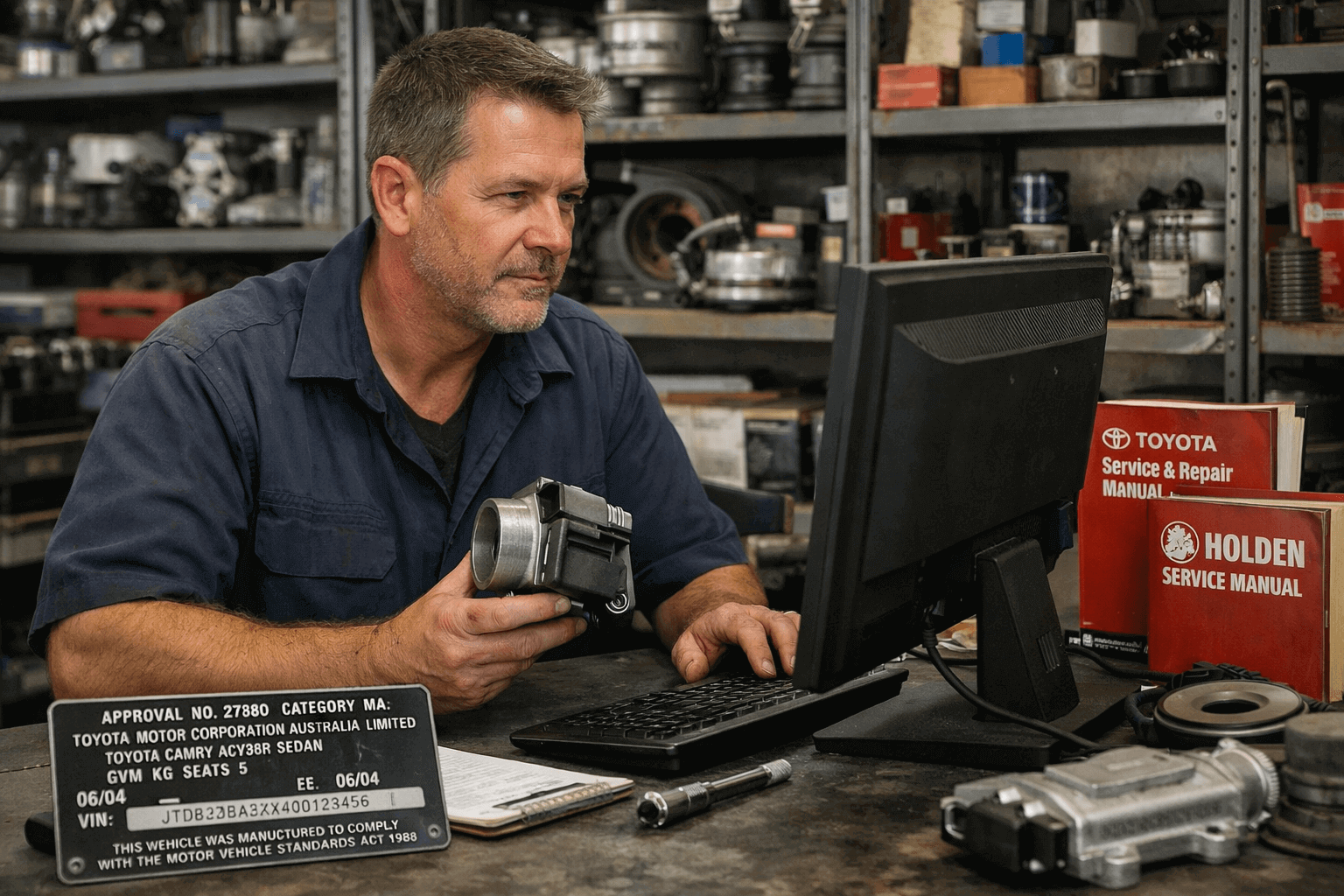
Your VIN (Vehicle Identification Number) is the 17-digit code stamped on your compliance plate and rego papers. It tells you everything: build date, engine type, transmission, factory options, and manufacturing plant.
Where to find it:
- Driver’s side door jamb (compliance plate)
- Bottom corner of windscreen (driver’s side)
- Registration papers
- Under the bonnet on some models
For Toyota, Holden, Ford, Mazda, and Hyundai — the brands most of us drive — the VIN breaks down which exact variant you’ve got. A Hilux SR vs SR5 might share a model name, but they’ve got different suspension components, different brakes, and different diffs.
How to use your VIN properly:
Pop it into parts websites like Repco, Burson, or Supercheap Auto. Their systems cross-reference it with manufacturer databases to show you parts that actually fit your specific build. Way more accurate than guessing based on “2018 Ranger”.
If you’re ringing a wrecker, read them the VIN. Good wreckers will check their inventory system and tell you straight away if they’ve got your car or a match.
Engine Codes and Chassis Codes: The Secret Weapons
Year and model get you in the ballpark. Engine and chassis codes get you the exact part.
Engine codes tell you which motor’s under the bonnet. A Commodore VE might have a 3.6L V6 (codes: LY7, LFX, or LLT, depending on year), or a 6.0L V8 (codes: L77, L98, LS2). Different codes = different parts for pretty much everything forward of the firewall.
Chassis codes narrow down the body style and variant. Examples:
- Toyota Corolla: ZRE152 (sedan), ZRE182 (hatch)
- Holden Commodore: VE, VF, VZ
- Ford Ranger: PX, PX2, PX3
- Mazda 3: BL, BM, BP
You’ll find these codes on the compliance plate or in your owner’s manual.
When you’re searching online for parts, chuck the chassis code into Google along with the part name. “ZRE152 headlight” gets you way better results than “2007 Corolla headlight” because it filters out all the non-matching variants.
How to Search for Car Parts Online (Without Getting Burned)
Online’s convenient, but you’ve gotta be careful. Here’s my process:
Step 1: Get Your Details Sorted
Before you even open Google, grab:
- VIN
- Build date (month and year)
- Engine code
- Chassis code
- Current part number (if you can see it on the old part)
Step 2: Check OEM Part Numbers First
If you want to be 100% certain you’re getting the right bit, find the manufacturer’s part number. Ring your local dealership parts department, give them your VIN, and ask for the part number. They’ll look it up for free.
Once you’ve got that OEM number (like “90915-YZZF2” for a Toyota oil filter), you can:
- Google it to find cheaper aftermarket equivalents
- Search eBay for genuine parts being sold for cheaper than dealer price
- Cross-reference it on Repco or Burson to find their house-brand version
This is the bulletproof method. OEM part numbers don’t lie.
Step 3: Use Proper Parts Websites
These sites actually verify compatibility:
- Repco, Burson, Supercheap Auto: Enter rego or VIN, and they show what fits
- RockAuto (ships from USA): Cheap, massive range, but check shipping times and import costs
- eBay: Good for OEM and wrecked parts, but verify seller knows Aussie variants
- Amazon Australia: Hit and miss, double-check part numbers
Avoid random Shopify dropshipping sites that just list “universal fit” parts with no VIN lookup. They’re importing cheap Chinese stuff and hoping it works.
Step 4: Search Smart on Google
When you Google parts, use this format:
“[Chassis code] + [part name] + Australia”
Examples:
- “VE Commodore power steering pump Australia.”
- “PX Ranger intercooler piping”
- “BP Mazda 3 brake pads”
Adding “Australia” filters out American and European sellers. Adding the chassis code gets you exact matches.
If you’ve got the part number, search that directly: “90915-YZZF2” will show you every site stocking that exact filter.
Searching Local Car Wreckers: The Old-School Method That Still Works
Wreckers (or pick-a-part yards) are gold for parts that don’t wear out much: panels, interior trim, glass, suspension arms, gearboxes, diffs.
How to Find the Right Wrecker
Ring around and ask:
- “Do you have [make/model/year] in the yard?”
- Give them your VIN or chassis code
- Ask if you can pull the part yourself (cheaper) or if they’ll pull it
Most wreckers have online inventory systems now. Sites like Car Parts Australia or Just Parts let you search multiple wreckers at once.
Pro tip: Wreckers usually price used parts at 30–50% of new retail. If they’re asking more, you’re better off buying aftermarket new with a warranty.
What to Check Before You Buy Used
If you’re pulling parts yourself:
- Check build dates match (especially for electrical stuff)
- Test electrical parts if possible (bring a battery)
- Inspect for cracks, rust, or damage
- Grab any mounting brackets or bolts while you’re there
Don’t assume parts are interchangeable between similar years. A VY Commodore taillight won’t fit a VZ, even though they look nearly identical.
OEM vs Aftermarket vs Used: When to Use Each
OEM (Original Equipment Manufacturer)
Best for: Engine internals, safety stuff (brakes, airbags), complex electronics
Where to buy: Dealerships, online OEM suppliers
Cost: Most expensive, but you know it’ll fit
Example: Genuine Toyota timing belt for a Prado. Don’t cheap out on critical engine parts.
Aftermarket
Best for: Filters, brake pads, bushings, wear-and-tear items
Where to buy: Repco, Burson, Supercheap, Auto One
Cost: 30–70% cheaper than OEM
Quality range: Varies. Brands like Bendix, Ryco, Bosch, and TRW are solid. Random no-name Chinese brands? Hit and miss.
Example: Ryco oil filter instead of a genuine Toyota. Same quality, half the price.
Used/Recycled
Best for: Body panels, interior trim, glass, gearboxes, diffs, and mechanical parts that don’t wear much
Where to buy: Wreckers, Facebook Marketplace, Gumtree
Cost: 30–60% of new
Risk: No warranty, usually, the condition varies
Example: VE Commodore door from a wrecker for $150 vs $800 new.
How to Confirm Compatibility Before You Buy
Here’s the checklist I run through before ordering anything:
1. Match build dates
If your car was built in 06/2015, try to get parts from cars built within 6 months on either side. Manufacturers update parts constantly.
2. Check engine and transmission match
Don’t assume all variants of the same model have identical drivetrains. A Ranger 2.2L diesel uses different parts from a 3.2L.
3. Verify chassis code
BL Mazda 3 parts won’t fit a BM. VE Commodore parts won’t fit a VF. Even one letter makes a difference.
4. Cross-reference part numbers
If you’ve got the old part, find its part number (usually stamped or labelled). Google it. Make sure the new part has the same number or is listed as a direct replacement.
5. Ask the seller
Seriously, just ring them. “Mate, I’ve got a 2014 Hyundai i30, VIN is [read it out], will this part fit?” Good sellers will check. Dodgy ones will say “yeah, should be fine” without checking — avoid them.
6. Read the product description properly
Look for:
- “Suits VIN: XXXX to XXXX”
- “Build date: 01/2013 to 12/2015”
- Specific engine codes listed
- Left-hand drive vs right-hand drive (matters for some parts)
If the listing just says “fits 2015 Corolla” with no other details, be suspicious.
Where Aussies Go Wrong When Googling Part Numbers
Mistake 1: Copying US part numbers
American parts databases dominate Google. Their part numbers often don’t match Australian-delivered cars because we get different specs. Always double-check Aussie suppliers.
Mistake 2: Not checking superseded part numbers
Manufacturers update part numbers. The old number might be discontinued, but there’s a newer replacement that’s identical. Ring the dealer parts dept to check the supercessions.
Mistake 3: Trusting “universal fit” claims
Unless it’s genuinely universal (like a generic tow bar or seat covers), assume “universal” means “we don’t actually know what it fits.”
Mistake 4: Forgetting about grey imports
If your car was privately imported or is a Japanese domestic model (like a JDM WRX or Skyline), Australian parts databases won’t help. You’ll need to source from Japan-specific suppliers or importers.
Mistake 5: Not checking return policies
Especially with online orders. If you order the wrong part, can you return it? Electrical parts are often non-returnable once opened. Know before you buy.
Quick Checklist: Before You Order Any Car Part
Use this to avoid stuff-ups:
Information gathered:
- [ ] VIN number
- [ ] Build date (month/year)
- [ ] Engine code
- [ ] Chassis code
- [ ] Current part number (if possible)
Compatibility confirmed:
- [ ] Seller verified fitment using VIN
- [ ] Part number matches or is confirmed replacement
- [ ] Build date range includes my vehicle
- [ ] Engine/transmission variant matches
- [ ] Left-hand drive vs right-hand drive checked (if relevant)
Purchase details:
- [ ] Return policy understood
- [ ] Warranty included (if buying new/aftermarket)
- [ ] Shipping time acceptable
- [ ] Total cost compared to alternatives
- [ ] Seller has good reviews/reputation
Final Word: Take Five Minutes, Save Five Headaches
Look, I get it — you just want the part ordered so you can get back on the road. But rushing the search process is how you end up with a starter motor for a Commodore V6 when you’ve got a V8, or brake pads for the wrong wheel size.
Spend five minutes getting your VIN, chassis code, and part number sorted. Ring the dealer or a good parts supplier if you’re unsure. It’s way less painful than dealing with returns, refunds, or having your car off the road for an extra week.
And if you’re really stuck? Hit up a local mechanic or auto electrician. Most of us are happy to look up a part number for you, especially if you’re planning to fit it yourself. We’ve all been there, and we’d rather see you get the right part first go.